Get Full Government Meeting Transcripts, Videos, & Alerts Forever!
Get email alerts on the Zoning Density Cbd topic
No spam. Unsubscribe anytime.
Salisbury council adopts zoning change to raise downtown density to 80 units per acre
Summary
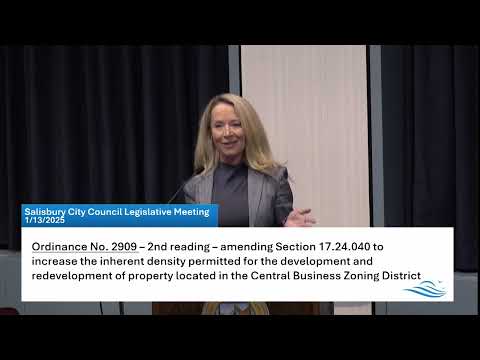
After a lengthy public hearing with competing testimony on parking, accessibility and developer plans, the Salisbury City Council approved Ordinance 2909 to increase allowable residential density in the central business district from 40 to 80 units per acre.
The Salisbury City Council voted to adopt Ordinance 2909, increasing the central business district's maximum residential density from 40 units per acre to 80 units per acre after an extended public hearing and council discussion.
Supporters told the council the amendment responds to a recent circuit court ruling that removed a longstanding mechanism for approving extra units, and that modest increases in downtown housing will produce more attainable units. Opponents pressed the council for a pause, saying parking, historic character and developer incentives were not sufficiently studied.
Brian Showalter, speaking on behalf of Salisbury Town Center Apartments, said the project at the center of the debate was always planned for “226 residential units” and that the change is intended in part to address a court decision that reduced downtown density. “This is not a doubling of this density,” Showalter said. “It does increase from 70 to 80 units per acre.” Showalter told the council the text change restores capacity the city relied on when preparing its comprehensive and downtown plans.
Several residents described practical concerns. Carter Harwood, a downtown resident who uses mobility aids, warned about reduced or more complicated public parking and stressed that accessibility must be considered both during and after construction. “As density of a given area increases, public parking decreases or becomes more complex to, utilize, the availability, the viability of accessing stores, restaurants, and public utilities are significantly hindered,” Harwood said.
Other speakers offered sharply different takes. Shemy Heater, who said she has worked downtown for 18 years, argued greater downtown density is environmentally preferable to sprawl and noted the Infrastructure and Development staff reported an existing average density in the CBD of about 3.75 units per acre. “Downtown is less dense than my sleepy little neighborhood,” Heater said, urging the council to approve the amendment.
Business owners and longtime residents also split. Holly Worthington, who owns a downtown business, said she had seen “too many unknowns” and asked why the number 80 was chosen. “This density once increased cannot be reversed,” she said, asking for formal studies assessing impacts on parking and historic character. In contrast, Jeremy Norton, a downtown restaurant owner, said housing is the city’s core need: “We need more houses. That’s just it. It doesn’t matter whether they’re luxury. Doesn’t matter whether they’re affordable. It’s basic supply and demand.”
Council discussion repeatedly returned to parking. Council President Derry framed the matter as a parking problem rather than a pure density debate and urged better data. “We blew up the parking standard a number of years ago,” Derry said, adding that some proposed projects are self-contained with on-site parking but others will create new demand the city must address. Derry also questioned the magnitude of the change’s effect on overall housing supply, saying the marginal increase would not “move the needle” citywide.
Opponents asked for a delay so the council could review a parking-lot study before a second reading. Councilwoman DeShield moved to table the ordinance to await parking study results; that motion did not carry. The council then proceeded to voice votes; multiple “aye”s were heard and at least one member verbally opposed before the chair announced that Ordinance 2909 passes.
Several procedural and legal issues surfaced in public comment. Robert Taylor, a member of the public who said he was a plaintiff in the underlying court case, said the council’s action will moot an intended appeal. Carolyn Waughnessy said she had filed a new Open Meetings Act complaint and criticized the council for having “already made up” its mind before public hearing testimony.
The council approved the ordinance without a recorded roll-call vote in the legislative session transcript; council members and commenters said they expect follow-up work on parking, accessibility and affordability as projects proceed.
The text amendment will alter how future downtown projects are sized and reviewed; council members and residents requested further study and follow-up reporting on parking mitigation and accessibility measures.