Get Full Government Meeting Transcripts, Videos, & Alerts Forever!
Get email alerts on the Zoning Cbd Density topic
No spam. Unsubscribe anytime.
Heated public hearing on proposed downtown density increase; supporters cite housing supply, opponents cite affordability and process concerns
Summary
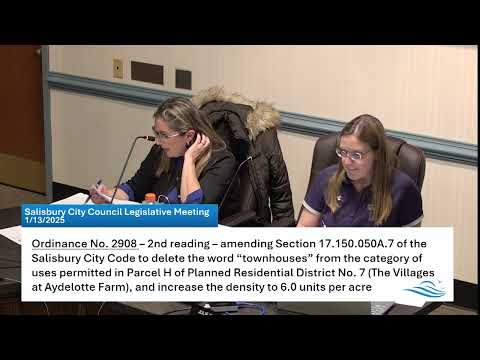
The Salisbury City Council opened a public hearing on Ordinance No. 2909, a proposed text amendment to increase allowable density in the Central Business District, and heard more than two dozen speakers both supporting and opposing the change.
The Salisbury City Council opened a public hearing on Ordinance No. 2909, a proposed text amendment to §17.24.040 of the Salisbury City Code to increase inherent density permitted in the Central Business District (CBD). The hearing drew more than two dozen speakers with sharply divided views.
Molly Hillegas, chief executive officer of Habitat for Humanity (and a Salisbury resident), said the Maryland Department of Planning projects household growth in Wicomico County and that Salisbury has the most capacity for water and sewer connections among county municipalities. She told the council the projection of future household growth and an imminent expansion of graduate medical education at TidalHealth support higher downtown density to house incoming medical personnel. "Density is absolutely the answer," she said.
Joey Gilkerson, who identified himself as a developer and downtown business owner, also supported the amendment and said dense downtown development saves infrastructure costs compared with sprawl. "Increased density is best for our community," he said.
Several speakers urged caution or opposed the change. James Yamakawa, chair of the Housing and Economic Development Committee for the Wicomico NAACP (Fruitland), said the chapter's support is "tentative" and conditioned on guarantees that new units will be affordable. He asked, "What guarantees are there that any of this new housing will be affordable?"
Other opponents — including long-term city residents, downtown business owners and speakers identifying concerns about process — raised several recurring points: that the city's Department of Infrastructure and Development staff issued a report saying staff "cannot support the current text amendment" (as cited by public commenters), that the Planning and Zoning Commission waived a community impact statement and a letter of financial capability, and that parking and traffic studies remain incomplete. Several speakers asked the council to delay action until traffic and parking studies are finished and until a community impact assessment is available.
Speakers also raised allegations about the development process and public trust: a commenter said a prior council letter to the Planning and Zoning Commission (dated July 31, 2024) reflected preexisting council support for the amendment and posed an Open Meetings Act concern; another speaker urged Council President Doherty to recuse himself because of his employment with Green Street Housing, which commenters said stands to benefit from density increases. These are allegations voiced during public comment and attributed to the individuals who raised them.
The Greater Salisbury Committee, represented at the hearing by its president and CEO Mike Dunn, urged approval and tied the density change to long-standing downtown revitalization studies and new public investments; Dunn also noted a $2 million design grant the Maryland Department of Housing and Community Development awarded earlier that day for a performing arts center.
Other themes: multiple residents expressed fear of displacement and gentrification, citing past demolition and community impacts; several speakers said downtown housing typically rents at higher rates and questioned whether unconstrained density will yield affordable units. One commenter cited the city's Horizon program, saying the developer would receive five years of full tax abatement and an additional 15 years of partial abatement (a claim made during public comment and attributed to that speaker).
Action taken at the meeting: council members moved and seconded a motion to approve Ordinance No. 2909 for second reading and opened the public hearing. The transcript captures the hearing and public comments but does not record a final council vote on the ordinance; the item remained under consideration at the close of the recorded public testimony.
The hearing featured extensive public input from housing advocates, business leaders, neighborhood residents and civic organizations. Several speakers asked the council to table the ordinance pending completion of traffic, parking and community-impact studies; others urged council approval to accelerate housing production.