Get Full Government Meeting Transcripts, Videos, & Alerts Forever!
Get email alerts on the Council Procedures topic
No spam. Unsubscribe anytime.
Salisbury counciltables review of new rules after public outcry over limits on comment and council president powers
Summary
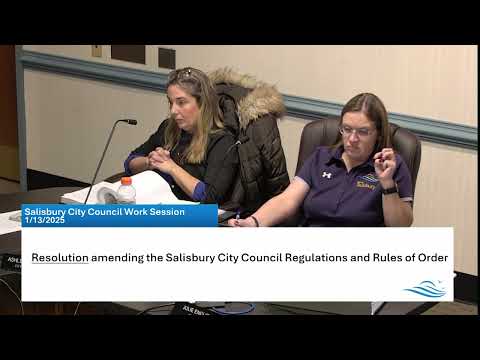
Salisbury City Council voted to table proposed revisions to its Regulations and Rules of Order after extended council discussion and more than a dozen public commenters criticized limits on public comment, the document’s format, and expanded authority for the council president.
Salisbury City Council on the evening paused consideration of a proposed revision to its Regulations and Rules of Order after lengthy council debate and sustained public comment that criticized the draft for reducing public participation and concentrating authority in the council president.
The move came after council members and the public debated provisions that would (as drafted) let the council president limit the number of times an individual could speak during the public comment period, make public comment at the end of a work session rather than after each agenda item, and set a uniform time limit for comments. Council members voted to table the item and take an additional week for one-on-one discussions and revisions.
The rules discussion centered on section 12 (public comment and participation) and a clause that allowed the council president to “limit the number of times and the amount of time a member of the public may speak.” Councilwoman DeShield urged striking language that could limit how often a person may speak; she said the change made her “very uncomfortable” and that speakers should be able to address more than one agenda item. City Clerk Julie English explained the draft reflected practices the clerk’s office and staff had followed and that the draft drew on other municipalities’ procedures.
Public commenters strongly criticized the drafting process and substance. Carolyn Wolgamuth, a Salisbury resident, said the draft “was crafted by the individual seeking more power to the detriment of the public,” and called the document “a blatant attempt to obscure what rights are being taken away from the public and what powers are being bestowed upon the council president.” Joseph Venuza, a resident and local producer, told the council, “my concern, my disgust frankly, at the then council's proposed limits on public comments. It demonstrates a stunning lack of inclusion for community voices.” Other commenters raised procedural and access concerns, including virtual participation, registration requirements, and the absence of a clear strike/underline edit showing deletions and additions.
Council members debated practical impacts. Several said a consistent time limit (typically three minutes in other municipalities) provides a baseline and administrative simplicity; others objected that placing comment only at the end of a work session removes the public’s chance to speak before votes or decisions. One council member noted that many municipalities do not allow public comment during work sessions, while another said the city had previously permitted speaking during work sessions and that public input should not be curtailed.
After discussion, a council member moved to table the rules for further consideration and one-on-one consultations among council members; another member seconded the motion. The motion passed on a voice vote with members responding “aye.” The clerk indicated she would rework the draft to reflect points of consensus and return a revised version to a future work session.
The tabling preserves the status quo rules until the council reconvenes the topic. Council members said the next iteration will clarify whether public comment rules differ between legislative sessions and work sessions, whether comment is heard after each work-session item, the uniform time limit to use (three minutes was frequently cited as a baseline in members’ research), and how registration and virtual participation will be handled.
Citizens who spoke urged transparency in the drafting process and clear edit marks so the public can see deletions and additions; several commenters warned the draft could be perceived as limiting speech or excluding vulnerable residents. Several made technical and legal suggestions, including referencing Roberts Rules and ensuring exceptions (for disability access or longer testimony) are applied fairly. The council did not adopt any substantive changes during the meeting; instead, members directed further internal discussion and asked the clerk to produce a revised draft that incorporates the points the council reported as consensus.
The rules item will return to a future work session with edits for council review. In the interim, the clerk will continue to accept public comments and will publicize changes before the revised draft is placed back on the agenda.