Get Full Government Meeting Transcripts, Videos, & Alerts Forever!
Get email alerts on the Community College Albany Campus topic
No spam. Unsubscribe anytime.
LCCC president outlines Albany campus role, transfer pathway and local training programs
Summary
Laramie County Community College President Schaeffer updated the Laramie City Council on the Albany campus’ history, its role serving UW students and local high school dual-enrollment, the new Express Transfer Agreement pilot with the University of Wyoming, and plans for workforce training and community partnerships.
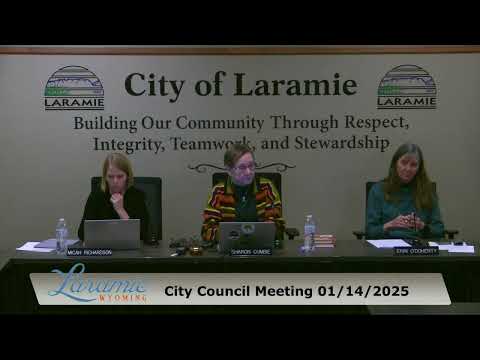
Laramie County Community College President Scott Schaeffer briefed the Laramie City Council on Jan. 14 about the college’s long-standing presence in Albany County, recent program developments, and a new transfer initiative with the University of Wyoming.
Schaeffer said LCCC has operated an Albany presence since 1977 and opened a permanent Laramie facility in 2005. The campus serves four primary roles: supporting University of Wyoming students who need supplemental instruction (particularly co‑requisite math), expanding dual‑ and concurrent‑enrollment options for high school students, providing customized employer training and professional development, and delivering adult basic education and high‑school‑equivalency services.
He described the Express Transfer Agreement (ETA) being piloted with UW for a small number of programs beginning this fall. Under ETA, students are dually admitted to LCCC and UW from day one, receive a guaranteed, locked‑in curriculum pathway, and are assigned advising contacts at both institutions. Schaeffer said the approach is designed to reduce confusion about credit transfer and to strengthen the pipeline for students who intend to complete a bachelor’s degree after earning an associate degree.
Schaeffer reported that the Laramie campus serves roughly 1,100 unduplicated students across program types in a 12‑month period, with about 700 students in the most recent fall term; he said the campus employs roughly 50 staff. He noted the college recently paid off bond obligations on the Laramie facility (bonds were retired in 2024), freeing revenue for operations.
Schaeffer outlined several workforce and community programs: automotive technical instruction housed at Laramie High School (33 enrolled this fall), culinary dual‑enrollment (11 enrolled), phlebotomy completers from recent semesters, and planned OSHA 10 and supervisor/soft‑skills training in partnership with the Laramie Chamber Business Alliance. He said the college continues to explore tailored training for local manufacturers and healthcare partners and that customized employer training is typically delivered in Laramie when feasible.
Councilors asked about governance, funding and service-area rules for Wyoming community colleges; Schaeffer explained by statute each community college has a district and an assigned state service area and said LCCC’s district is Laramie County while its service area includes both Laramie and Albany counties. He noted Laramie County property taxes contribute materially to LCCC’s revenue mix and that the Albany campus must balance state funding, tuition and program revenue to operate.
Schaeffer asked the council to consider continued partnership on workforce initiatives and acknowledged the college’s involvement in local coalitions (he thanked the city for providing meeting space for the Albany County Housing Coalition). He said the ETA pilot will begin with a small number of programs — elementary and secondary education, business and criminal justice — and expand if successful. No formal council action was requested; the presentation was informational.