Get Full Government Meeting Transcripts, Videos, & Alerts Forever!
Get email alerts on the Policy Revisions topic
No spam. Unsubscribe anytime.
Board committee advances five policy revisions and one new whistleblower policy to first reading
Summary
The policy committee reviewed five policies—employment contracts, emergency preparedness, opioid antagonist (name change and updates), a new whistleblower policy and Title I parent engagement—and recommended first reading on Jan. 27.
The Hatboro-Horsham policy committee reviewed five policy items at the Jan. 13 work session and recommended they move forward for first reading at the Jan. 27 legislative meeting.
Administrators and committee members described changes to employment-contract procedures, emergency-preparedness expectations, a rename and update to the opioid reversal policy, a new whistleblower policy and a refreshed Title I parent and family engagement policy. Dr. Jomers led the packet review and introduced policy authors and staff, including Christine Welsh, Dr. Andre McLaurin and school safety staff.
Revisions to Policy 308 (employment contracts and board resolutions) clarify employee categories, resignation procedures and notice periods (for example, professional employees have a 60-day notice expectation; noncertificated administrative and support staff are expected to give two weeks). Committee members asked that resignations offered in lieu of termination be brought to the board; administration said resignations accepted by the superintendent or designee are treated as irrevocable absent board action and that typically such matters would have been discussed with the board in advance.
Policy 805 (emergency preparedness) was updated to align with state code and to add definitions for security assessments and school security drills; the revisions also formalize training and drill expectations (monthly fire drills, at least one school-security drill within the first 90 days and up to two additional security drills annually, bus-evacuation drills, and staff training elements emphasizing situational awareness and trauma-informed approaches). Committee members requested clarified language to notify the community about drills; administrators said communication to families and post-drill messaging are already part of practice and that certain emergency notifications will be tested and communicated in advance when appropriate.
Policy 823 is a name change from "Naxolone" to "opioid antagonist" to cover FDA-approved emergency opioid-reversal drugs; the revision clarifies school nurse responsibilities for building-level stocking and administration. Policy authors said the change broadens the policy to include similar FDA-approved products.
The committee also reviewed a new Policy 829 (whistleblower). The proposed policy defines wrongdoing, fraud and waste; allows written, anonymous or escalated reporting to a supervisor, superintendent/designee or board president; requires investigation of complaints and provides anti-retaliation protections for good-faith reporters. Administration emphasized the policy is proactive and not prompted by any single incident.
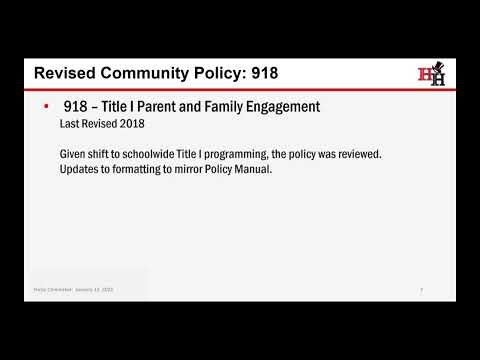
Finally, Policy 918 (Title I parent and family engagement) was reformatted to align with the policy manual and to restate strategies for family engagement under federal Title I requirements; administrators said no substantive federal changes required language edits but the policy was refreshed for clarity.
The committee recommended all five items move to the Jan. 27 legislative meeting for first reading.