Get Full Government Meeting Transcripts, Videos, & Alerts Forever!
Get email alerts on the Greenhouse Gas Reduction Plan topic
No spam. Unsubscribe anytime.
Burbank Water and Power reports 11% emissions drop since 2019; staff outlines GGRP progress and next steps
Summary
Burbank Water and Power staff reported an 11% community greenhouse gas emissions reduction from 2019 to 2022, highlighted targets and actions in the city’s Greenhouse Gas Reduction Plan, and told the Planning Commission staff will continue implementation and seek grants to fund measures.
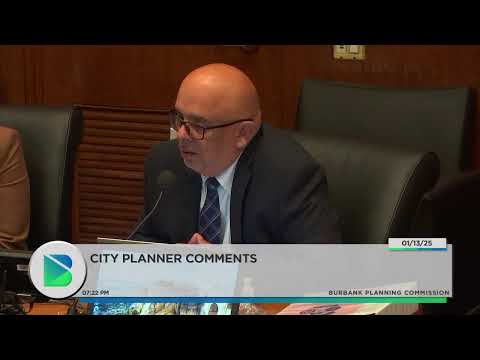
Drew Johnstone, sustainability officer at Burbank Water and Power, presented a status report to the Planning Commission on Jan. 13 summarizing progress under the city’s Greenhouse Gas Reduction Plan (GGRP) and outlining next steps.
Johnstone said the city’s most recent greenhouse‑gas inventory shows an 11% reduction in community emissions between 2019 and 2022. He said the largest emission sources remain buildings (electricity and natural gas) and transportation, which together account for more than 95% of community emissions. The GGRP includes 12 strategies, 21 measures and roughly 124 action items; staff will report annually through the CapDash tool and provide qualitative updates in a status‑report addendum.
City departments collaborate on implementation: Community Development leads on building electrification, transportation demand management and complete‑streets efforts; Public Works manages methane capture at the landfill, municipal fleet electrification planning and organic‑waste diversion under SB 1383; and Burbank Water and Power (BWP) runs customer rebate and electrification programs and is responsible for power supply.
Johnstone said BWP current power deliveries are about 42% carbon‑free and that the utility has an internal goal to reach 100% carbon‑free supply by 2040 and a state‑driven target of 60% renewable by 2030. He described a target with Burbank Housing Corporation to electrify 100 of its units by 2030 and all units by 2045; to date staff reported four completed electrifications. Johnstone emphasized the scale of the work, noting the plan represents a multi‑decade investment the status report estimates could total in the billions when combined with other city plans and infrastructure work.
Commissioners asked how growth and the city’s RHNA (Regional Housing Needs Allocation) obligations factor into energy and emissions planning. Johnstone and other staff said energy‑procurement and integrated resource planning at BWP look decades ahead and account for anticipated increases in electricity demand from population growth, electrified buildings and electric vehicles, while the utility seeks long‑term contracts, grant funding and other resources to meet demand and emissions goals. Staff also said additional work and staffing will be required to accelerate multifamily electrification efforts and that a project manager position to lead electrification coordination is a near‑term priority.
Johnstone said staff will continue outreach and implementation, that the status report and CapDash data are posted online, and that he will present the report to City Council on Jan. 28. The Planning Commission placed the report on file.