Get Full Government Meeting Transcripts, Videos, & Alerts Forever!
Get email alerts on the Police Hiring Traffic topic
No spam. Unsubscribe anytime.
Cleveland police report hiring gains; council presses for more traffic enforcement and neighborhood focus
Summary
Police told the committee the department currently has 1,137 sworn officers and 81 recruits in the academy; council members urged using new hires to expand traffic enforcement in neighborhoods and asked for data to guide resource decisions.
Police and city officials updated the committee on recruitment results and traffic-enforcement capacity, and council members urged a stronger, neighborhood-focused enforcement plan.
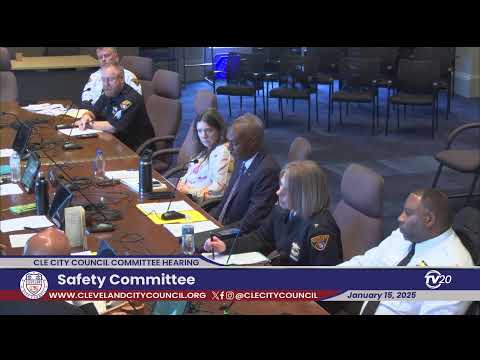
Chief Todd and senior staff said the division currently lists 1,137 sworn officers and has 81 recruits in the police academy, bringing the total projected sworn count to about 1,218 once recruits graduate. The department reported a successful hiring event in January that produced roughly 136 conditional offers; the new class(s) are slated to begin and graduate in April (chair and staff cited April 25 and April 28 dates for academy activity, and the chief said the class scheduled to start from the recent hiring event will begin late April). The division said it will continue quarterly hiring events and may request additional budgetary authority to increase class capacity; the department’s current budgeted authorized headcount was stated as 1,350 officers.
Committee members pressed police and the director of public safety to apply new hires toward traffic enforcement in neighborhoods. Council members described frequent constituent complaints about speeding and unsafe driving, and they said speed tables alone are not a comprehensive remedy. Officials explained that traffic enforcement requires a combination of strategies: enforcement, traffic-calming infrastructure (speed tables, re-timed signals), environmental street design, and community ownership. Commissioner Holmes (traffic) explained that each patrol district maintains two dedicated traffic cars and that the centralized traffic unit fields roughly 21 vehicles plus over 20 motorcycles for summer operations; the traffic unit reported writing about 12,000 tickets in the prior year. Council members asked police and administration to return with a multi-year comparison of moving-violation enforcement and related revenue, and to explore ways to keep traffic enforcement in neighborhoods rather than shaving resources downtown where special events demand coverage.
Police and council members discussed the cost and limits of speed tables (speakers gave an approximate range of $8,000 per installation depending on street width), the impact of large downtown events on district-level capacity and the potential to expand interagency initiatives like Ohio State Highway Patrol enforcement details during high-need periods. The chief said the department will continue to prioritize traffic concerns, pursue interagency partners and review deployment choices as hiring expands.
No legislation was adopted at this update; committee members requested follow-up data and asked the department to study district-level traffic coverage and possible reallocation of enforcement resources.