Get Full Government Meeting Transcripts, Videos, & Alerts Forever!
Get email alerts on the Intersection Study topic
No spam. Unsubscribe anytime.
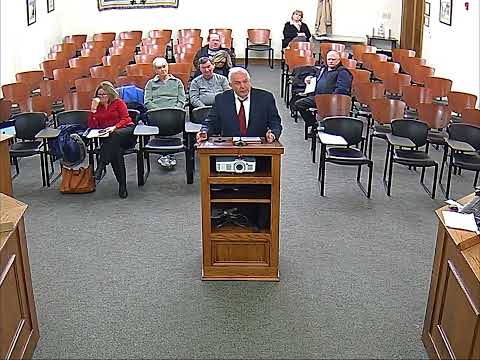
Troy committee approves $120,000 study to update design for West Main (SR 41) and Experiment Farm/Stanfield intersection
Summary
The Troy Streets and Sidewalks Committee unanimously authorized staff to amend a consultant contract for up to $120,000 to produce an ODOT-standard feasibility study that will determine whether a roundabout or a conventional intersection is appropriate at West Main Street (State Route 41) and Experiment Farm Road/Stanfield.
On Jan. 13, 2025, the Troy Streets and Sidewalks Committee voted unanimously to ask staff to amend the city’s contract with American Structurepoint to produce an Ohio Department of Transportation (ODOT)-standard feasibility study for the West Main Street (State Route 41) and Experiment Farm Road/Stanfield intersection at a cost not to exceed $120,000.
The study will update work done in 2021, when the city’s design engineer recommended a roundabout and the city applied for federal construction funds. Committee members and staff said ODOT now requires additional analysis under updated modeling standards for complex roundabouts before it will confirm whether it will continue to support the roundabout design or direct a conventional intersection alternative.
City staff said the consultant’s supplemental work would take about three to six months and that the city expects another public meeting in late spring to present results and gather public input. Christy B. Terrace, assistant city engineer, said, “we would anticipate American Structurepoint being done in about 3 to 6 months…so I would anticipate that in late spring time frame.”
Staff told the committee that the city previously budgeted $500,000 for detailed design work based on the earlier roundabout concept and that approximately $2,500,000 in federal construction funds has been programmed for the project through the regional transportation plan. The committee was told the federal funds risk being lost if the project does not advance on the schedule established through the regional programming process.
Todd Sievert, council member at large, pressed staff on whether the project qualified for safety-specific funding and whether the timing could be delayed to ease traffic impacts from nearby construction. City staff clarified that the intersection does not meet ODOT’s statistical thresholds for safety-targeted funds but does qualify for congestion-mitigation funding and that ODOT’s review, not the city alone, controls final design decisions tied to federal funding eligibility.
Committee chair Bob Phillips summarized the action: staff requested authorization to amend the consultant contract up to $120,000 to produce ODOT-standard analysis. The motion carried unanimously among committee members present.
The study’s findings will determine whether the city proceeds with a roundabout, an expanded conventional intersection, or another traffic-control solution; staff noted any resulting design and bid timeline would affect the city’s final construction schedule and costs. Staff said construction, if advanced on ODOT’s current schedule, is tentatively programmed for 2028.