Get Full Government Meeting Transcripts, Videos, & Alerts Forever!
Get email alerts on the Historic Preservation topic
No spam. Unsubscribe anytime.
Local historian recounts Evergreen Ballroomhistory, plans kiosk commemoration
Summary
At a Lacey Museum history talk, researcher Rebecca Sanchez outlined the Evergreen Ballroom: its founding by Walter Schoeland, a midcentury run of major performers and local bands, fires in 1931 and 2000, surviving archival material and posters, and a planned kiosk plaque in Lacey Park.
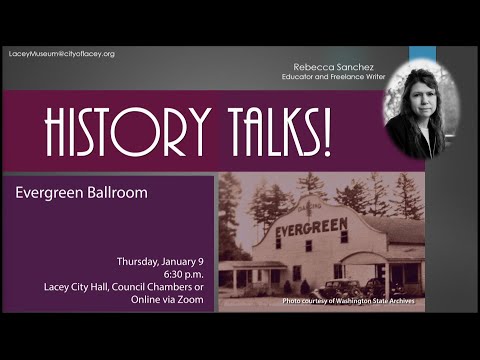
Rebecca Sanchez, an educator and freelance writer, presented a chronological account of the Evergreen Ballroom during a Lacey Museum history talk, tracing the venue from its 1931 opening through its role as a midcentury music stop and its destruction by fire in 2000.
Sanchez said the ballroom was built by Walter Schoeland and opened in May 1931 as the Evergreen Pavilion, with the venue described in period advertisements as "7 miles east of Olympia on Tacoma Highway" and featuring music from Schoeland's orchestra. She reported the structure was rebuilt after a November 1931 fire and reopened in June 1932 as the Evergreen Colonial Ballroom.
The presentation summarized archival sources Sanchez used: local newspapers, census records, Washington State Archives and Library holdings, the Thurston County assessor field book, and oral interviews with former performers and attendees. "From the research that I did, I saw an immigrant story. I saw the story of opportunity, the story of youth, and the story of diversity in Thurston County," Sanchez said.
Sanchez described the building's size and amenities as reported in contemporary coverage and assessor records: a hall roughly 70 by 120 feet with a maple dance floor (listed at about 1,670 square feet), living quarters for a manager, a concession stand and an orchestra shell; she said early construction costs were reported at $15,000. Early admission prices quoted in advertisements included supper for 35 cents and admission for $1; later 1930s and 1950s notices listed different price points and promotions (for example, gents 75 cents and ladies free at a 1932 advertisement).
Sanchez placed the Evergreen Ballroom in the wider regional circuit, noting its location on what older accounts called the "kerosene circuit" between Olympia and Tacoma and its appeal to touring acts. She said many nationally known performers and influential regional acts appeared there across several decades, naming, among others, Louis Armstrong, Duke Ellington, Ray Charles, James Brown, Johnny Cash and Ike and Tina Turner, and noting that local and regional bands often shared the stage with touring stars.
Interview material Sanchez cited included recollections from Bill Engelhart of Little Bill and the Blue Notes and from Steve Bean, a former employee of radio station KGY, who described occasional live recording and promotion of shows. Sanchez also cited the late Ken Bosley and local archival collectors whose material has been digitized on regional sites such as PacificNorthwestBands.com.
Sanchez recounted that the venue's later years included changes in ownership and programming; she said Richard Campbell bought the ballroom in 1965 and later owner Fawn Marcus booked both live acts and DJ nights. She described a pattern reported in local coverage and interviews: as the interstate freeway network shifted long-distance traffic to I-5, secondary highway venues saw changing attendance patterns.
On July 20, 2000, the Evergreen Ballroom burned; Sanchez cited Lacey Fire Department reports described during her talk that firefighters received an initial call at 3:20 p.m., the structure collapsed about 45 minutes after reporting smoke, and the fire spread to nearby brush requiring multiple agencies to respond. Several audience members who spoke during the session recalled the fire and earlier inspections that noted the building construction type made large fires difficult to contain.
Sanchez concluded by describing surviving material in local collections: posters, a small number of photographs, and assessor field records. She said community members have posted memories and photos online and the Lacey Museum plans to include community-submitted recollections when it reopens in a new Belltown Centre location later this year. The Thurston County Historic Commission and others are moving forward with a kiosk panel at a nearby park (Marvin and Stilacoom) that will include a panel commemorating the Evergreen Ballroom site.
Audience members contributed additional memories in a question-and-answer period: former performers and attendees described Sunday-night dances for minors, shuttle arrangements from Greyhound stations advertised in midcentury notices, and the ballroom layout including double stages and manager living quarters. Some attendees also recalled instances of racial harassment at events in the 1960s; Sanchez attributed those recollections to individual audience speakers and archival interviews.
The talk closed with museum staff asking attendees to submit memories and materials by email to the Lacey Museum address shown during the presentation; Sanchez and museum staff said they will use those contributions in future exhibits and local interpretive panels.
Ending note: The Lacey Museum said its physical Russell House site closed in November and will reopen at the Belltown Centre on 6th Avenue later in 2025; the existing site will remain a research center for archives and genealogy materials.