Get Full Government Meeting Transcripts, Videos, & Alerts Forever!
Get email alerts on the Public Safety Ems topic
No spam. Unsubscribe anytime.
Council committee advances ordinance to create deputy chief for EMS budget and compliance
Summary
Fall River committee passed the ordinance through first reading to create a contract deputy chief of emergency medical services responsible for budgeting, grants and billing compliance after department leaders described rapid growth in call volume and billing complexity.
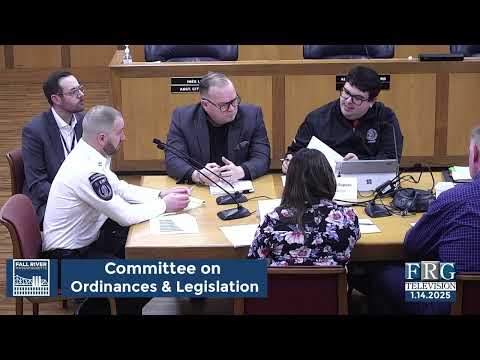
The Committee on Ordinances and Legislation on Nov. 17 advanced an ordinance to establish a deputy chief of emergency medical services for budget and compliance, voting to pass the proposal through its first reading.
City Administrator Seth Aiken told the committee the city proposed the position because EMS responsibilities have expanded beyond 911 response to include mobile integrated health (MIH) programs and new contracts. “The time has really come, in the estimation of the people that know best within EMS to create a deputy chief to deal with the finances, the PCG grant, which is, could be 1,000,000 of dollars every year, the billing,” Aiken said, adding that outside billing would likely cost the city more than hiring the in‑house position.
Chief Silva, who presented operational detail, described rapid growth in calls and programs and said MIH “focuses on instead of just pre hospital 9 1 1 care taking people to the hospital. It actually involves paramedics going out into the home and doing actual home care in conjunction with some of the hospital groups.” Silva said increasing regulatory and payer scrutiny creates compliance risk: he cited a recent out‑of‑state hospital fine he summarized as “a little bit over $1,000,000” and said the city wants to avoid similar penalties.
Councilors asked about pay, staffing and whether billing would remain in house. Aiken said the new deputy would be a contract position paid above current deputy chiefs and intentionally outside the union to preserve independence for budget oversight. Chief Silva said EMS currently employs three billing clerks and uses automated platforms that generate run reports routed into a billing queue that staff and a deputy chief review for compliance. Silva said the department’s budget is approximately $13 million and that keeping billing in house preserves high collection and accuracy rates.
Councilor Raposa pressed for salary comparability; Aiken said the post would likely be paid above other deputy chiefs because of its technical responsibilities. Councilor Samson asked whether a third‑party biller was being considered; Silva described the existing automated billing system and the department’s preference to maintain in‑house billing given current collection accuracy.
The committee voted to pass the ordinance through first reading by voice vote. No effective date or salary figure was specified in the discussion; Aiken said, if adopted, the city would move “almost immediately” to negotiate an agreement and fill the role.
The discussion also addressed organizational chart changes and potential need for additional clerical support if call volume and MIH grow. Silva said the deputy chiefs currently perform many administrative tasks and that additional clerks could be added later as volume increases.
Votes at a glance Motion: pass ordinance through first reading to establish deputy chief of EMS for budget and compliance. Motion seconded; voice vote “Aye.” Outcome: passed (first reading).