Get Full Government Meeting Transcripts, Videos, & Alerts Forever!
Get email alerts on the Conservation Districts Recharge Erosion topic
No spam. Unsubscribe anytime.
Arizona conservation districts tell committee they coordinate local recharge, erosion control and post‑fire recovery statewide
Summary
Derek Knight, treasurer of the Arizona Association of Conservation Districts, told the House Natural Resources committee that 42 conservation districts cover the state and coordinate local projects including recharge basins, erosion control, brush management and post‑fire infrastructure replacement.
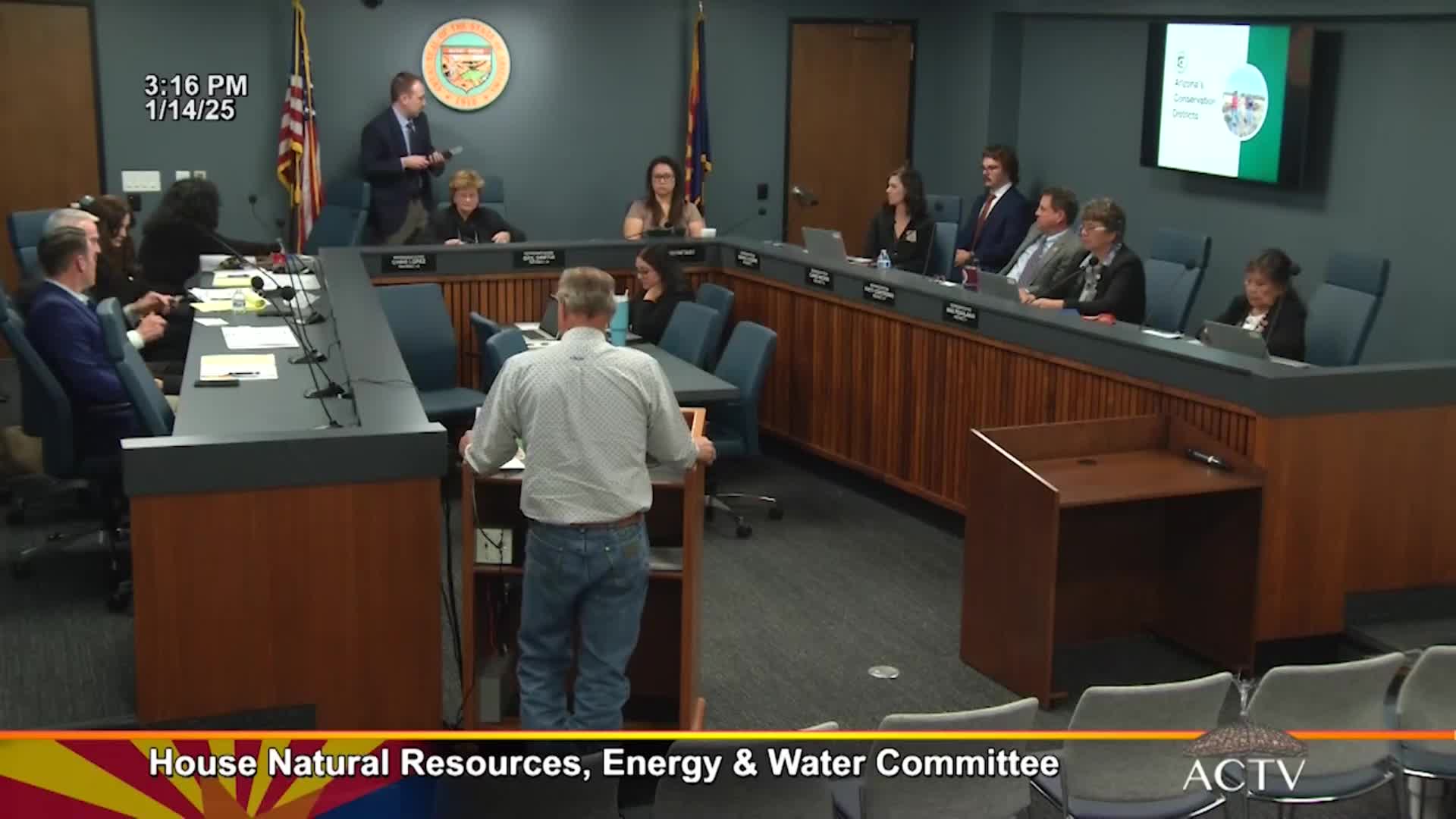
Derek Knight, treasurer of the Arizona Association of Conservation Districts and chairman of a local NRCD, told the House Natural Resources, Energy and Water Committee that 42 local conservation districts cover every inch of Arizona and coordinate local projects such as recharge basins, erosion control, brush management and post‑fire recovery.
Knight described conservation districts as statutorily authorized political subdivisions that use voluntary, cost‑share programs to deliver conservation practices and technical assistance. He listed funding and program partners that districts use to get work on the ground, including the USDA Natural Resources Conservation Service (NRCS), Farm Bill programs, the Water Infrastructure Finance Authority of Arizona (WIFA), the Bureau of Land Management and various non‑profit partners.
Knight and members said conservation districts run local work groups that identify needs and priorities, organize education and field days, and administer on‑the‑ground projects ranging from grassland restoration to infrastructure replacement after wildfire. He provided examples of active projects and funding levels in multiple districts: Apache NRCD projects with about $11,000,000 in conservation funds active in that district; Tonto area projects totaling roughly $13,000,000; and other districts with multi‑million dollar activity. He said the districts also support smaller local recharge and flood‑detention projects that capture runoff and assist groundwater recharge.
Committee members noted that the Department of Water Resources and State Trust Lands had identified about 331 potential recharge sites statewide and that some existing detention basins, used historically for flood control, could be reclassified or maintained as recharge basins but require ongoing maintenance. Knight said districts pursue a wide range of funding sources and that implementations are typically voluntary and done through cost‑share arrangements or grants rather than enforcement.
Members discussed maintenance needs for projects in Wilcox and other areas; Knight and the chair noted that statutory authority, local partnerships and continued state support for upkeep are central to sustaining those benefits. Knight requested committee support for awareness and programs that help maintain and expand local recharge and restoration work.