Get Full Government Meeting Transcripts, Videos, & Alerts Forever!
Get email alerts on the Suicide Prevention topic
No spam. Unsubscribe anytime.
San Diego County Suicide Prevention Council releases 2024 community report and action-plan update
Summary
The San Diego County Suicide Prevention Council and partners announced the public release of the SPC Community Report 2024 and the Suicide Prevention Action Plan (SPAP) 2024 update, highlighting a 12% decrease in annual suicide deaths since 2019 but recent increases among specific groups and new countywide prevention activities.
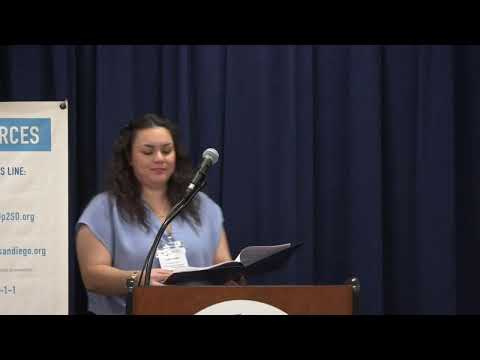
San Diego County officials and community partners onstage at a press conference announced the public release of the Suicide Prevention Council (SPC) Community Report 2024 and the Suicide Prevention Action Plan (SPAP) 2024 update, saying the reports are tools for communitywide prevention work.
The SPAP 2024 update and the SPC report, presenters said, summarize 10 years of county data and outline strategies to reduce suicide across San Diego County. "In 2023, there were 363 suicide deaths among San Diego County residents," Dr. Luke Bergman, behavioral health services director for the County of San Diego, said. "This represents an overall 12% decrease compared to 5 years prior in 2019 when 460 people died in our county as a result of suicide."
The reports matter because they combine mortality and near-real-time clinical data, identify populations with rising suicide risk, and list prevention strategies and trainings countywide. The SPC presentation emphasized that while overall deaths have fallen compared with 2019, recent years show increases in certain groups that require focused interventions.
Dr. Bergman said the county observed a 6% increase in suicide deaths between 2021 and 2023 and pointed to sharper rises in some groups: "From 2021 to 2023, suicide rates increased, for example, 51% for non Hispanic black residents," he said, and "there was a 56 percent increase in the suicide rate among those 10 to 24." He also noted that the highest rate of suicide death remains among middle-aged and older non-Hispanic white men, particularly in East County, and emphasized means-reduction work: "Overwhelmingly, males who attempt suicide do so using firearms. And overwhelmingly relative to other means of suicide attempt, firearms are deadly. We need to keep pressing on safer use and opportunities for safer storage."
Presenters described prevention activities already underway. The county said mobile crisis response teams deployed to school districts have reached students through the "Helping, Engaging, Reconnecting, and Educating" (HEAR Now) program, which the county reported has reached more than 38,100 students. Behavioral Health Services has expanded suicide screening pilots in federally qualified health centers in rural areas and created a near-real-time surveillance report using syndromic emergency-department data. The SPC and partners also reported increasing Question, Persuade, Refer (QPR) gatekeeper trainings and other trainings: "In 2023, the suicide prevention council hosted 142 suicide prevention trainings, reaching almost 2,000 people," Dr. Bergman said.
Speakers urged community action and use of the materials. Sebastian Slovan, founder of Nature Unplugged and a member of the SPC, framed the role of conversation and community connection in prevention: "Suicide and the stigma and the shame ... it really thrives in the shadows," Slovan said, calling on attendees to check in with loved ones, download the SPAP update, and consider training or volunteering with the council. Linda Puebla of Community Health Improvement Partners (CHIP), which facilitates the SPC, closed the event by noting the 2024 update is available in multiple languages and by directing attendees to spcsandiego.org for the reports and resources.
The release is a public-information action rather than a legislative change; presenters did not record any formal votes or policy adoptions during the press conference. Instead, speakers positioned the SPAP 2024 update and the community report as reference tools for agencies, schools, health providers, and residents to adopt evidence-based screening, train community members, and expand means-reduction education.
The SPC said the 2024 update expands content from the 2018 plan, adds CDC- and community-informed risk and protective factors, includes new qualitative material on COVID-19 impacts, outlines community-recommended strategies based on the nine strategic areas from the 2018 update, provides a more robust evaluation framework, and will be available in additional languages (Arabic, Tagalog, Vietnamese, Korean, and Persian) beyond the initial English, Spanish, Chinese, and Somali translations.
Post-conference materials and QR codes link to the full SPC report, the SPAP 2024 update, and information about hosting or attending trainings. Presenters said they would make themselves available for interviews after the event.