
Alpine School District transportation staff outline fleet, staffing and budget challenges ahead of split into three districts
Get AI-powered insights, summaries, and transcripts
Sign Up Free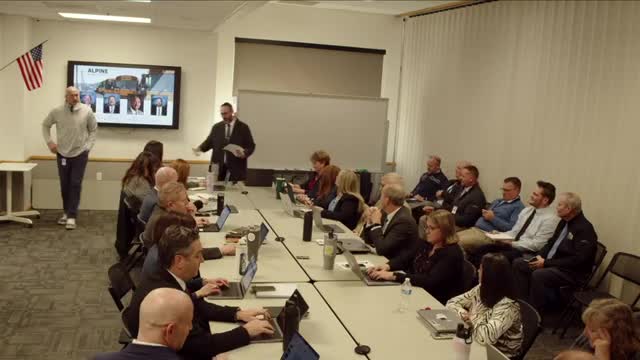
Summary
David, East Transportation Hub, told the Alpine School District board at a study session that district transportation will face significant operational and budget choices as the district prepares to split into three new districts (West, Central and South).
David, East Transportation Hub, told the Alpine School District board at a study session that district transportation will face significant operational and budget choices as the district prepares to split into three new districts (West, Central and South).
David summarized the department's scale and shortfalls: the system runs about 218 routes made up of roughly 1,154 runs, serves more than 6,000 bus stops and transports nearly 18,000 students each weekday; the fleet travels more than 3,000,000 miles annually. He said the district counts about 86,000 students total, of whom roughly 24,000 are eligible for busing; the transportation department currently carries almost 15,000 eligible students and an estimated 3,000 students who are not eligible under state mileage rules, bringing the operational daily total to about 18,000 riders.
Why this matters: the split will require reallocating buses, drivers, mechanics and facilities across three new jurisdictions. David said staff modeled resource splits based on eligible ridership, which they interpret as the state will reimburse only “eligible” routes. "The state reimburses us back $1.07 per eligible mile," David said, and staff "estimate that to be about 80%" of eligible operating costs reimbursed, though the final percentage is set by the state fund allocation each year.
The presentation distilled state eligibility rules used by the department: students living 1.5 miles or more from elementary schools, and 2 miles or more from secondary schools, are eligible for transportation; the department counts runs and routes differently when submitting for reimbursement (stops → runs → routes). For reimbursement the district models a run as eligible if it includes at least 10 eligible regular-education riders (staff said special-education-related criteria differ and may allow smaller counts).
Key resource and budget figures presented
- Fleet and staff: roughly 360 buses (about 30 buses in a long-term repair or "boneyard" status), about 300 drivers, roughly 80 bus attendants, about 16 mechanics and a small team of trainers and supervisors. - Routes and ridership: 218 bus routes, 1,154 runs, more than 6,000 stops, nearly 18,000 daily riders (about 15,000 eligible). - Finances: transportation generated about $15.4 million in operating revenue in FY 2022–23/23–24, plus roughly $1.4 million in school fees and about $8,000 in driver testing fees, for an estimated total operating revenue of about $16.8 million. Operating expenses were roughly $20.7 million, producing a near‑$4 million operating deficit; when capital needs are included staff said the total deficit is about $6.2 million. Major recurring costs cited included fuel (~$1.6 million annually), bus repair/maintenance (~$1.4 million) and software maintenance (~$300,000).
Capital and immediate needs
Staff described a near-term capital ask of approximately 50 new buses at an estimated cost of $5,000,000 for the coming year (the presentation corrected an earlier figure and said "5,000,000 for 50 buses"). Several older buses in the boneyard would be expensive to refurbish; staff said a single engine replacement could run tens of thousands of dollars and that some boneyard vehicles are not cost-effective to repair. David also said the district needs to replace failing radio repeaters (estimated ~$40,000) and needs service-center capacity on the west side; staff have previously budgeted roughly $6 million toward a west service center but estimated an additional $4 million to $7–9 million could ultimately be required depending on final design (staff cited figure ranges of roughly $10–15 million in different slides and said Frank would bring updated cost numbers later).
Options for organizing transportation after reconfiguration
Staff presented three high-level options: - Unified transportation: maintain one consolidated transportation system after the split, governed by an interlocal agreement or memorandum of understanding (MOU) covering bus purchases, maintenance and personnel decisions. - Tiered transition: split one district (for example, West) first while Central and South continue to share services temporarily, with formal separations phased later. - Clean split: immediately form three independent transportation systems.
David and his colleagues walked through a tiered example, saying West currently lacks a service center and would either need an MOU with Central for maintenance, lease temporary facilities or accelerate construction of the planned west service center. They cited an existing intergovernmental example (a Logan–Cache agreement described in staff field visits) where one partner manages operations and the other purchases vehicles and pays a percentage of costs.
Driver availability and operational constraints
Staff repeatedly warned that driver shortages, not bus counts alone, drive capacity. They noted driver totals peaked around 2019–20, fell to a low in 2022–23 and have been recovering. The department uses some practices that complicate a split (for example, drivers who pick up buses at one compound and run routes in another to avoid long commutes). Staff estimated typical fleet downtime at about 10% for repair and servicing and said districts generally need a reserve fleet for flexibility and crossover routes.
Activity trips and rate structure
Transportation staff said the district heavily subsidizes activity trips: the department charges about $4 per mile for activities but estimates a true cost closer to $12 per mile. That discount reduces revenue and contributes to the operating deficit but is maintained currently to keep costs low for schools, teams and families.
Other operational notes
- Special education and McKinney‑Vento students: staff said forecasting special-education program locations and transportation needs is especially complex and makes long-term routing forecasts uncertain. - In-lieu payments and vans: the district uses an "in-lieu-of" mileage reimbursement when buses cannot reach a home and operates a small number of 14-passenger activity vans (staff said three vans are in use, mainly to transport special-education students where full-size buses cannot access roads). - Outsourcing repairs: staff said outside shops can be substantially more expensive and may not prioritize the district's buses; larger districts typically keep mechanics in house.
Board discussion and next steps
Board members asked for more data on the number and cost of ineligible riders currently transported; staff said the counts are available from October head counts and that isolating ineligible riders is sometimes difficult because they are picked up on eligible routes. Board members asked staff to model district-specific routing earlier in the planning process so the district can better estimate the number of buses and drivers each new district would need. Several board members and staff expressed a practical preference for a tiered approach with West separating earlier and Central and South remaining together at least for a transition period, though no formal board decision on structure was taken at the session.
Quotes from transportation staff
"We transport nearly 18,000 students every single day," David said when giving system totals.
On funding, David said, "The state reimburses us back $1.07 per eligible mile" and added, "We estimate that to be about 80% is what we expect back." Joe noted the subsidy on activities: "We charge $4 a mile; our best guess is that it costs us $12 and we charge 4. So it's 12 to 4. We estimate that we charge a third of what it costs."
What staff were directed to do
Staff were asked to begin modeling uncoupled (district-specific) routes and resource allocations as soon as possible so the board and transition teams can refine estimates for buses, drivers, service centers and mechanics ahead of any formal split. Board members also encouraged staff to return with clearer counts of ineligible riders being carried today and updated capital cost estimates for the west service center.
Ending
Transportation leaders said they will continue refining models and return with updated numbers; they emphasized driver recruitment and retention, fleet renewal and service-center capacity as the highest priorities in making any reconfiguration sustainable.