Get Full Government Meeting Transcripts, Videos, & Alerts Forever!
Get email alerts on the Zoning Planned Development topic
No spam. Unsubscribe anytime.
DuPage County hearing on Chinmaya Mission planned development draws safety and traffic concerns
Summary
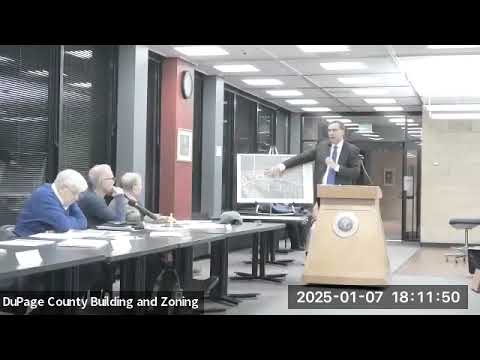
The DuPage County Zoning and Planning Commission held a public hearing Jan. 23 on case 24-0077, an application by Chinmaya Mission Chicago for a conditional use planned development in Downers Grove Township that would add residential units and a small commercial building while seeking a limited height exception.
The DuPage County Zoning and Planning Commission held a public hearing Jan. 23 on case 24-0077, an application by Chinmaya Mission Chicago for a conditional use planned development in Downers Grove Township that would combine two parcels totaling roughly 24–25 acres and add detached and attached residential units and a small commercial building while seeking a limited height exception.
The applicant, represented by attorney Phil Lutkehans, told the commission the project would preserve the mission’s existing 10,500-square-foot building, add a one-story 17,900-square-foot addition for education and services, and include a roughly 14,000–14,172-square-foot commercial building intended to serve residents. “We’re only seeking a 3 foot height exception,” Lutkehans said, clarifying the request was to raise the building height to about 40 feet rather than the 47 feet noted in the notice.
The proposed development spans two parcels the applicant described as about 8.15 acres (north) and 16.3 acres (south). Lutkehans said the plan would provide a mix of housing marketed largely to older members of the faith community and estimated a total residential density substantially below what nearby R5 and R6 zoning would permit. The project team distributed seven exhibits, including a survey, site plan, traffic study (exhibit 4, with a two-page supplement 4a to add the commercial building), a landscape plan and a copy of the county dark skies ordinance (exhibit 7).
Traffic and parking were a primary focus. Steven Corcoran, director of traffic engineering at Ericsson Engineering, summarized the traffic study and said the analysis used weekday AM and PM peak hours rather than Sunday counts, noting the mission’s largest traffic occurs on Sundays. Corcoran described expected trip generation for the proposed residential and commercial uses using standard residential and retail rates: “We would be generating roughly 38 trips in and out in the morning and 48 in the evening peak hour,” and he said the shopping center could add up to 93 afternoon peak-hour trips under conservative assumptions. Corcoran concluded his analysis did not recommend roadway improvements for Route 83 because of existing medians and nearby comparable access points.
The Tri State Fire Protection District objected to the project as presented. The district’s Director of Fire Prevention, Mulligan, said the fire district received its first notice of the development only with the county’s meeting notification and said the district had not had adequate time or information to evaluate emergency and water-supply impacts. “Our main, we’re not in favor of the project at this time,” Mulligan said, citing concerns about parking on grass for large events, Sunday traffic that was not included in the study, and whether paved access could support heavy apparatus.
Local residents and school district officials reiterated safety and traffic concerns. Lisa Martin, who lives directly adjacent to the site, told the commission parking and vehicles often spill onto the frontage road on Sundays and said vehicle headlights and additional queuing worry her. Amanda Frankel, president of the CCSD 180 Board of Education, said the district might need to serve any children who move into the development and flagged potential hazards for school buses on Route 83 and at the Bluff Road intersection, calling Bluff Road “a hazard already.” Joanne Krypel, a CCSD 180 board member who said she was neutral on the project, asked whether new homes would be sold as fee simple or leased and whether the commercial building would be publicly signed; Lutkehans replied that the residential units would be taxable (not land tax-exempt) and that any signage would be limited to a monument sign allowed by ordinance.
The project team described parking increases and design measures intended to reduce external impacts: Lutkehans said permanent parking on the north parcel would increase from 102 to 111 spaces and that the south parcel would provide additional spaces and a roughly 90-space grass overflow lot the applicant said is used only four or five times a year. The landscape architect said the plan adds significant new parking overall—“we’re increasing the parking by over 133 spots total”—and that walking paths would link residences to the mission to reduce short trips by car.
Commissioners and staff noted outstanding technical reviews and conditions. County staff and the applicant referenced compliance with DuPage County zoning standards and stormwater requirements; the applicant said it will obtain required stormwater permits and comply with relevant regulations and would adopt the county dark skies provisions listed as exhibit 7. The architect and applicant said they would work with the fire district during site and building permitting to address access and water-supply concerns and that the Swami’s house visible on the site is separately permitted construction.
No final zoning decision was taken at the hearing. The commission recorded a one procedural motion at the start—allowing absent members to participate in the hearing—which passed on a voice vote; commissioners did not take a final vote on case 24-0077. The record was left open for written public comment up to two weeks before the commission’s recommendation meeting on Thursday, Feb. 6, when staff and commissioners will consider recommendation language for the county board.
The hearing combined technical testimony from the applicant’s design and engineering team with public safety input and neighborhood concern. The applicant asked the commission to forward a recommendation of approval to the county board; fire officials and several residents asked for additional review and for the record to reflect unresolved issues about emergency access, Sunday traffic, and parking.