Get Full Government Meeting Transcripts, Videos, & Alerts Forever!
Get email alerts on the Vice Mayor Term Rotation topic
No spam. Unsubscribe anytime.
Mesa council discusses one‑year vice‑mayor rotation, stops short of vote
Summary
Councilmember Duff proposed rotating the vice mayor position annually so every member serves; city attorney said Mesa's charter requires selecting vice mayor(s) for a two‑year period within 30 days. Council agreed to continue researching charter changes and succession implications rather than vote at the study session.
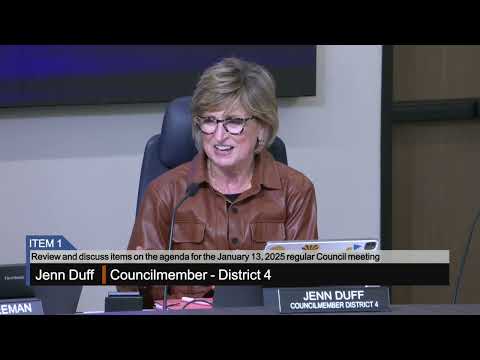
Councilmember Duff proposed that the Mesa City Council adopt a one‑year, rotating vice‑mayor practice so every council member would have the opportunity to serve.
"I'd like to suggest that we consider a 1 year alternating term like Phoenix and other cities have," Councilmember Duff said, adding the change would "take a lot of drama out of it" and give each member an opportunity to serve.
The city's legal officer noted a limit in the charter. The City Attorney said the charter's Section 203(b) requires the council to select vice mayor(s) to fill the next two years within 30 days, meaning the council can either name one person for two years or name two different people now to serve one year each for 2025 and 2026. "You could pick 2 different people for 1 year terms, but you have to fill those 2 years within the next 30 days," the City Attorney said.
Councilmembers and staff discussed options and tradeoffs, including whether to pursue a charter amendment to change the selection cycle. Several members said a charter change would be the more permanent solution but would take time. "Ultimately, the institutional way would be to get a charter change and just take that out," one staff member said.
Members also raised succession and contingency questions tied to changing term lengths. Councilmember Summers and others noted that how the vice mayor succeeds to the mayoralty differs depending on when a vacancy occurs; under the current rules the vice mayor can become mayor pro tem and an election may be required within 120 days in some circumstances. Summers said those succession mechanics should be examined before making selection changes: "I think we need to look at succession for the mayor and how that would look."
No formal motion to change the selection process or to amend the charter was taken at the study session. The council agreed to continue the discussion at the regular meeting upstairs and to do further research on practices used in other Arizona cities. "Discussion held," the mayor concluded.
Votes at the study session otherwise were procedural: the council acknowledged receipt of Parks & Recreation Board minutes and later adjourned; both procedural motions were approved by voice vote.