Get Full Government Meeting Transcripts, Videos, & Alerts Forever!
Get email alerts on the Emergency Services District topic
No spam. Unsubscribe anytime.
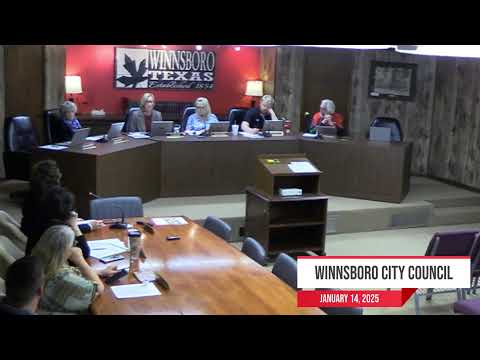
Winnsboro council reviews proposed county emergency services district, moves to executive session
Summary
Councilmembers heard an extended briefing on a petition to form a Franklin County emergency services district (ESD) that would levy a tax affecting about 404 properties inside Winnsboro, then voted to discuss legal issues in executive session under Texas Government Code §551.071.
Winnsboro city staff and the fire chief briefed the City Council on a petition filed to form an Emergency Services District (ESD) in Franklin County that would include roughly 404 properties inside Winnsboro city limits and could place a tax levy before voters.
City staff member Mackenzie, speaking during the agenda item, described the proposal as “an emergency services district is a separate political subdivision that operates independently” and said the district would “come with a tax levy that will impact approximately 404 properties in the city of Winnsborough, and the goal with this would be to get it on the May election.” Mackenzie told council members the county commissioners appeared inclined to delay a vote toward November and that, if so, petitioners would need to re‑petition the measure with about 100 property‑owning signatories from Franklin County.
The council discussed how funds from an ESD are allocated and who would control distribution. Council members and Chief Griffin asked whether an ESD collected in part from Winnsboro property owners would be spent in Winnsboro or diverted to other Franklin County departments. Mackenzie and another speaker explained that an ESD’s board, appointed by the Franklin County commissioners under the petition’s rules, would determine funding priorities; the city would not automatically receive a fixed portion. Council members were told the petition’s maximum proposed levy (as presented to the council) could be set as high as 10 cents and that there is no guarantee of an equal split among departments.
The council heard that ESD status changes certain taxpayer protections: staff clarified that if an ESD forms, existing homestead exemptions or tax freezes do not automatically carry over; the ESD could adopt exemptions but is not required to do so. Staff also noted that, as a separate political subdivision, an ESD can adopt fees, file insurance claims on incidents, and adopt fire codes independently.
After extended questions about who would decide budgets and a request to ensure Winnsboro receives fair treatment, a councilmember moved and seconded a motion to meet in executive session with the city attorney under Texas Government Code §551.071 to discuss legal issues related to the petition. The motion passed and the council cleared the chamber for executive session.
The council did not take a final vote on whether to place the ESD petition on the ballot during the public portion of the meeting; staff said the county process and a possible November timeline could require re‑petition of signatures.
The council indicated it would consider public outreach (a town‑hall) and further analysis if the election proceeds.