Get Full Government Meeting Transcripts, Videos, & Alerts Forever!
Get email alerts on the Municipal Sustainability topic
No spam. Unsubscribe anytime.
Kalamazoo reviews 2023 greenhouse gas inventory, outlines recycling and green‑energy steps
Summary
City staff presented the 2023 municipal greenhouse gas inventory and updates on recycling, composting pilots, electric vehicles and a Consumers Energy green‑power purchase that staff say will cut the city's electricity‑related emissions roughly in half under current accounting.
Kalamazoo City on Monday reviewed its 2023 municipal greenhouse gas inventory and described a string of waste, transportation and green‑energy initiatives city staff say are moving the municipality toward its net‑zero goal.
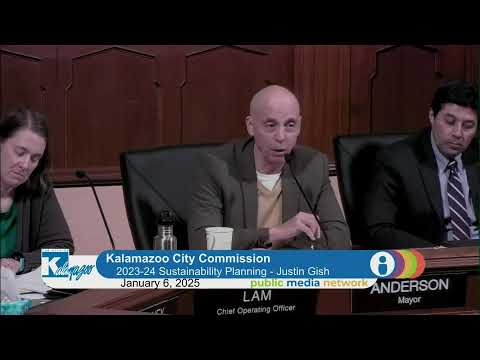
Justin Gish, the city’s sustainability planner, told the Committee of the Whole that “in 2023, we were responsible for 50,053 metric tons of CO2e,” a figure he said rose by less than 1 percent from the prior year after accounting for a late data submission. Gish said water and wastewater operations account for roughly half of the city’s municipal emissions and that a pending green‑power purchase will change how the city accounts for electricity use.
The accounting change stems from an agreement the city reached with Consumers Energy to purchase 48,000,000 kilowatt‑hours of renewable energy. Gish said the 48 million kWh allotment represents “almost 95% of the [city’s] electric use” and, in his accounting, will reduce the city’s reported emissions from electricity by about 52 percent once the program is in effect in 2028.
Gish walked commissioners through other 2023 and 2024 results: the city moved from zero to two electric vehicles in its fleet (a 200 percent increase), added 480 new residential recycling carts, received a $1,000,000 tree grant for planting and maintenance, and reported roughly 5,000 tons of compostable/recyclable material in 2024 against a 2,000‑ton goal for earlier years. He also said the city has completed approximately 50 percent of lead service line replacements and is targeting 75 percent by 2027.
On sector changes, Gish reported a 2.5 percent decline in emissions from buildings and facilities and a 4.9 percent decline for streetlights and traffic signals. He said the vehicle fleet showed an increase in emissions but that a 2023 switch to biodiesel lowered fleet emissions by about 86 metric tons of CO2e. Employee commute data appeared in the inventory for the first time and added roughly 1,500 metric tons of CO2e.
Public comment and operational details accompanied the inventory briefing. A resident who identified herself as a member of Hope for Creation praised the city’s recycling work and volunteer Styrofoam collection at Mayor’s Riverfront Park, saying the group’s volunteers are “really happy with the job that the city's doing.”
Chris Broadbent, the city’s solid‑waste coordinator, briefed commissioners on curbside recycling operations and contamination reduction efforts. “We have one recycle truck that does about 90% of the recycle routes,” Broadbent said, explaining why the city currently runs an every‑other‑week pickup cycle under a contract that runs through 2027. He described cardboard (corrugated OCC) as the highest‑value commodity on the market and urged residents to use curbside carts rather than bulk trash for boxes.
Broadbent and Gish described a contamination‑reduction effort that will use a camera system on truck 2421 (which covers about 90 percent of routes) to generate parcel‑level heat maps of contamination. The city will send direct mail postcards to households identified by the system as having contaminants. Broadbent said EGLE and the Recycling Partnership provided grant funding for an educational mailer program.
On composting, Broadbent said the city composts collected leaves and yard waste and that the city is seeking quotes (through January 16) for a neighborhood drop‑off food‑scrap collection pilot. He also described a city office collection that ships used single‑serve coffee pods to TerraCycle for processing.
Commissioners asked about weekly recycling pickup, downtown reusable container pilots, expanded EV chargers and using brownfield/capped landfill parcels for solar. Broadbent and Gish recommended studying route and emission tradeoffs before changing pickup frequency. Gish said a downtown reusable‑dish pilot did not launch because participating restaurants could not make the logistics work; the city had explored working with a vendor called Foreverware and other municipalities but the pilot did not scale in Kalamazoo this year.
On putting solar on capped or contaminated parcels, Chief Operating Officer Lamb cautioned that liability and engineering constraints are the chief obstacles: “The biggest single issue related to installing solar on those sites is concerns about liability,” Lamb said, noting that disturbance of a site cap could create regulatory and legal consequences and that many developers seek parcels much larger than typical urban lots.
Gish and Broadbent described other programs: a No Mow May signup that recorded about 380 participants covering roughly 33 acres; a gold certification from the Michigan Green Communities Challenge in 2024; and outreach partnerships with Western Michigan University and other local organizations for data and pilot projects.
No formal motions or votes were taken on the sustainability items at the Committee of the Whole meeting; staff said several pilots and procurement processes will proceed through future budget or contract actions.
Looking ahead, staff told commissioners they will continue tracking greenhouse‑gas metrics, pursue pilot programs for food‑scrap collection and contamination reduction, refine accounting for the Consumers Energy green‑power purchase, and pursue external grants and university partnerships to support data collection and implementation.