Get Full Government Meeting Transcripts, Videos, & Alerts Forever!
Get email alerts on the Building Benchmarking topic
No spam. Unsubscribe anytime.
Ann Arbor releases first annual energy and water benchmarking report; compliance climbs but remains incomplete
Summary
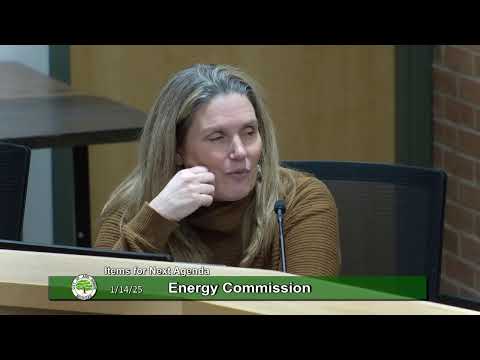
Connor Daley, the city’s energy coordinator, presented the City of Ann Arbor Energy and Water Benchmarking Annual Report at the Jan. 14 Energy Commission meeting, saying benchmarking participation and automated data access rose sharply during 2024 but that full compliance and data completeness remain partial.
Connor Daley, energy coordinator for the City of Ann Arbor Office of Sustainability and Innovations, presented the City of Ann Arbor Energy and Water Benchmarking Annual Report at the Energy Commission meeting on Jan. 14, 2025. The report summarizes benchmarking participation, data accuracy, utility access and early performance trends for properties covered by the ordinance enacted in October 2021.
Daley told the commission that benchmarking targets are intended to support future programs and property-level decisions and that the program’s objective is outreach and data collection rather than punitive enforcement. "When we're looking at building performance, we can't improve what we can't measure," Daley said.
The nut graf: benchmarking targets large commercial and multifamily buildings because buildings produce roughly two-thirds of local greenhouse gas emissions; a functioning, accurate data set is the first step to targeted policies or incentives.
Key findings in the presentation and report
- Compliance and participation: Daley reported compliance rose about tenfold through 2024, from roughly 3% compliance for 2023 reporting early in the year to an approximately 32% compliance rate for the most recent reporting year, with participation (properties that have started benchmarking) higher. For the 2021 compliance year Daley cited roughly 78% participation for that year’s cohort. Daley cautioned that the differing coverage thresholds between years (2021 required much larger buildings) make cross-year comparisons imperfect.
- Data accuracy and automation: Daley summarized utility-specific differences. Constellation Energy’s meter data were generally accurate and relatively easy to obtain by direct request or account download, but Constellation does not yet provide an automated data feed. DTE Energy offers an automated Data Hub that can push aggregated building-level data to EPA Energy Star Portfolio Manager, but enrollment can be tricky for property representatives who do not have account authorization; the Data Hub has remained a pilot and requires properties to join the Ann Arbor–Washtenaw 2030 District to enroll. The city’s AquaHawk system and a city-managed API provide automated water meter uploads for properties where meters are linked to the city account.
- Property-type trends: Multifamily properties account for the largest share of gross floor area currently benchmarking (57% of gross floor area among participating properties). Daley said property types with the highest energy-use intensity include laboratories, restaurants and ambulatory service centers; lowest EUI types include parking garages and non‑refrigerated warehouses. Water-intensity leaders were fitness centers, hotels and residence halls (noting University of Michigan properties are not covered by the ordinance and are excluded from the city’s metrics).
- City-owned properties: The city benchmarks its own buildings and said seven city properties meet the reporting threshold (city-owned properties of 10,000 square feet or more where the city regularly pays all or part of utility bills). Daley said city benchmarking is proceeding even for properties not required by the ordinance to help identify operational issues.
Enforcement and penalties
Daley emphasized that while the ordinance contains fines, the Office of Sustainability and Innovations’ stated preference is to obtain compliance through outreach, automation and technical support instead of immediate ticketing. During public comment, resident Ken Gerber asked directly when the city would begin levying the ordinance fines. Gerber asked: "When will the city start to levy the fines for non compliance that are specified in the benchmarking ordinance? I think that's $500 for first offense and $1,000 for every additional offense." Daley and commissioners said enforcement exists in the ordinance but that staff are prioritizing outreach and troubleshooting data gaps before pursuing civil penalties.
Next steps
Daley said the office will continue outreach to increase participation and compliance, expand automated data connections where feasible, and use the benchmarking dataset to design future commercial and multifamily efficiency initiatives. Commissioners and district partners recommended producing building-level scorecards that show owners year-to-year trends and peer comparisons inside Energy Star Portfolio Manager; Daley said Energy Star already produces comparative scores (relative-to-peer Energy Star scores) and the city will work on accessible scorecards for property owners and managers.
The presentation and the full 66-page report are posted on the Energy Commission agenda materials for Jan. 14, 2025. Daley invited follow-up questions and additional requests for breakdowns by property type and comparison with national medians or other jurisdictions.
Ending: Commissioners asked staff to pursue increased automation, targeted outreach to hard-to-reach properties, and clearer communications about enforcement timelines while preserving the city's stated preference for technical support and voluntary compliance first.