Get Full Government Meeting Transcripts, Videos, & Alerts Forever!
Get email alerts on the Greenbelt Scoring topic
No spam. Unsubscribe anytime.
Greenbelt advisory commissioners debate how to weight agriculture criteria in easement scoring
Summary
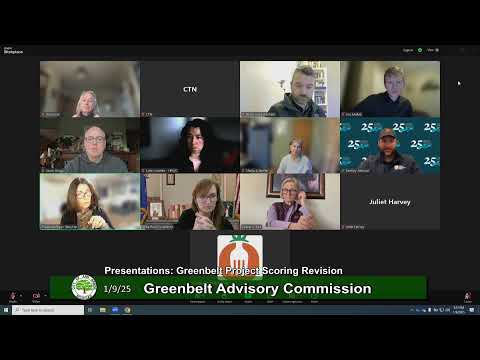
The Greenbelt Advisory Commission on Jan. 9 discussed changes to the scoring system it uses to recommend which agricultural properties receive funding or conservation easements, with no formal vote taken.
The Greenbelt Advisory Commission on Jan. 9 discussed changes to the scoring system it uses to recommend which agricultural properties receive funding or conservation easements, with no formal vote taken.
Rosie (staff member) explained that the scoring changes follow ordinance edits in 2024 that moved scoring details out of Chapter 42 and left the commission to approve a system. "I am going to take all of your final scores, and I have already run some statistics on them," Rosie said, describing staff’s plan to combine commissioners’ quantitative inputs with the meeting’s qualitative discussion when drafting a final scoring recommendation.
Commissioners focused early discussion on the category that measures the type or quality of agricultural land (prime soils). Rosie reported that commissioners’ numeric inputs for that metric ranged widely: "The highest, was 50. The lowest was 12." Several commissioners urged looking at the scores as both a numeric check and a prompt for discussion rather than treating the mean as the final decision. "If the average number feels, like, fairly comfortable to us, then that's, like, a good sign," Commissioner Kate said.
Debate centered on several recurring points:
- Parcel size and "bang for the buck." Remy (staff member) urged that larger parcels can deliver more protected acres per unit of staff time and legal work, noting that many of the program’s transactional costs do not scale linearly with acreage. "With less than 10 years to go before the millage expires, there's a certain amount of bang for your buck by prioritizing picking off larger pieces than smaller pieces," Remy said.
- Prime soils vs. future stewardship. Commissioners argued prime agricultural soils are an irreplaceable asset today, while others said good stewardship can improve soils over time. Rosie noted that prime-soil measures are based on soil type and not on metrics such as organic matter, and said the scoring system cannot practically rely on soil testing for every parcel.
- Conservation programs and current management. Commissioners differed on whether participation in programs such as cover crops or the Conservation Reserve Program should carry weight in scoring. Some scored this category high, arguing current management plus conservation practices yield visible landscape and water-quality benefits. Others scored it low or zero, saying those programs reflect current operators and are not guaranteed in perpetuity under an easement.
- Significant cultural value. Commissioners debated whether to keep a scored category for scenic or historic/cultural value. Several said the concept is important for deliberations but problematic to quantify. "Certain cultural values can be in conservation values," Rosie said, but added that placing a numeric weight on cultural value risks power dynamics and accountability challenges. Multiple commissioners suggested removing "significant cultural value" from the numeric scoring and instead ensuring applicants and staff provide required qualitative reporting on such features for closed-session deliberations.
Rosie described the process moving forward: staff will reconcile the quantitative spreadsheet results with the qualitative discussion from this meeting, revise the scoring draft, and return to the commission with a proposed final scoring system for consideration in February. "Just because the average score is 18 in a category, it may, after this discussion ... we may go, you know what? Everyone seemed that there was a general nodding of heads that that was sort of a tier 1 category, and maybe we need to up that to 25 to balance that out," Rosie said.
No motions or votes were taken on scoring at the meeting; commissioners agreed to continue and finish the agricultural scoring discussion at a future meeting before addressing open-space categories.
The discussion underscored trade-offs the commission is balancing: maximizing acres protected with limited millage time remaining, rewarding current on-the-ground conservation practices, and preserving flexibility to surface culturally important property attributes for deliberation without embedding them in a numeric score.
Commissioners and staff said they expect further adjustments before a recommended, commission-approved scoring system is finalized and presented to City Council.