Get Full Government Meeting Transcripts, Videos, & Alerts Forever!
Get email alerts on the Composting topic
No spam. Unsubscribe anytime.
Planning commission backs Richard Lands composting special-use request with dust-control, fencing conditions
Summary
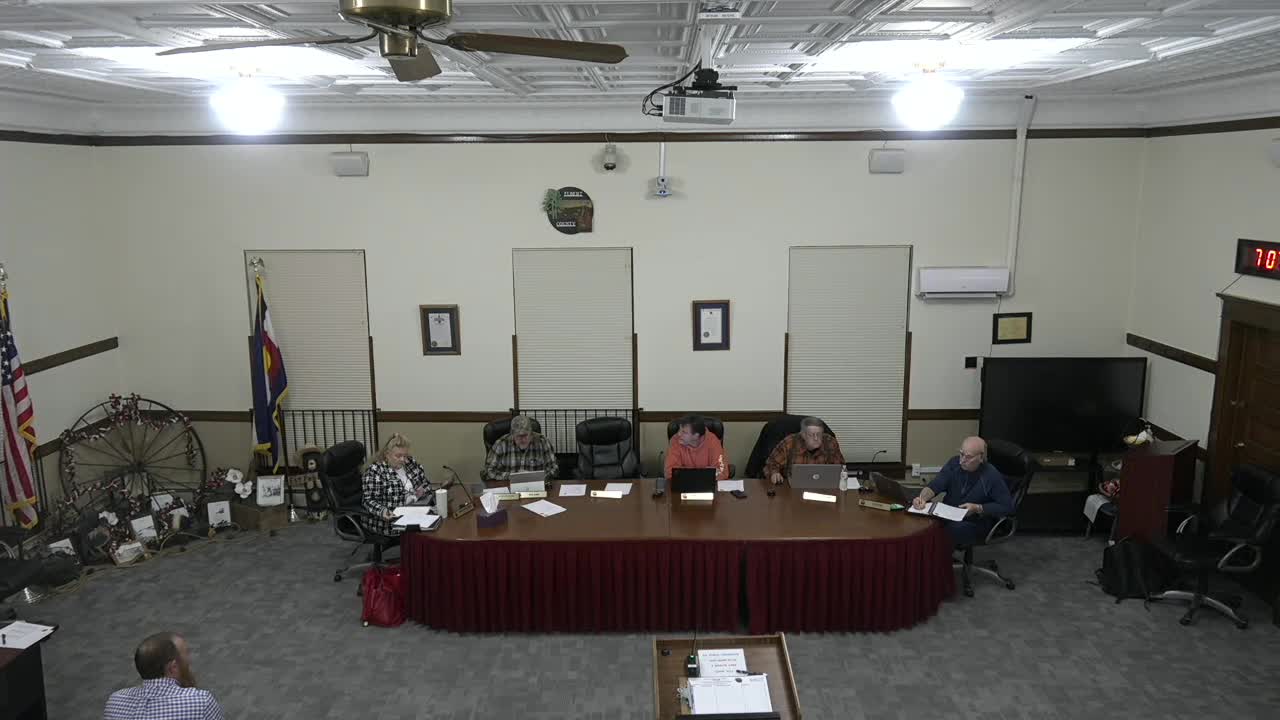
The Elbert County Planning Commission on Jan. 7 recommended approval of a Class II composting special-use by review for 15585 County Road 166 in Kiowa, adding conditions on dust control and fencing and forwarding the application to the Board of County Commissioners.
ELBERT COUNTY, Colo. — The Elbert County Planning Commission voted Jan. 7 to recommend the Board of County Commissioners approve a special-use by review (SUR 2023-1558) for Richard Lands Composting, a proposed Class II composting facility at 15585 County Road 166 in Kiowa.
The commission’s recommendation, which passed by voice roll call, included staff’s standard recording and permitting conditions and two added requirements: dust-control measures for the section of County Road 166 affected by truck traffic and county-required fencing or other security as necessary to prevent debris migration and illegal dumping. The measure now goes to the Board of County Commissioners for final action.
The proposal would place a composting operation on a 39.25-acre agricultural parcel. According to staff and the applicant’s materials, the facility would accept agricultural feedstocks — large- animal manure and bedding, straw and hay, woody waste, yard and agricultural plant waste — and operate under an engineering design and operations plan (EDOP) approved by the Colorado Department of Public Health and Environment (CDPHE). County staff said the EDOP meets CDPHE standards and that the facility is designed to limit odors, control stormwater and protect groundwater.
Planning staff described the site layout and controls: approximately an 8-acre compost pad, a detention/impoundment pond for contact water, three groundwater monitoring wells with quarterly sampling, a compacted clay base for processing areas, and buffers from neighboring property lines (roughly 120–130 feet to the east and west processing boundaries, about 600 feet to the south and about 1,000 feet to the north). A county traffic letter provided an estimate of roughly 54 vehicle trips per day associated with the operation. Staff recommended approval with conditions including removal of the public-hearing sign within seven days of the Board decision, payment of fees and recordation of the SUR exhibit within 180 days, providing CDPHE final permitting documents for county records, and obtaining a well permit before drilling into the nontributary Arapahoe aquifer.
At the public hearing, a nearby resident identified as Beverly told commissioners she and other neighbors have observed repeated dumping of manure by Colorado Manure Hauling trucks on County Road 53, creating numerous piles, flies and offensive odors. Beverly said piles had been spread at or near multiple homes and described the situation as a health hazard. The applicant, Jonathan Whetstein — who said he is a part owner of Richard Lands Composting and of Colorado Manure Hauling — acknowledged that material had been left at a private property where the landowner requested spreading, and said the transport-and-spread activity was separate from the permitted composting facility operations. Whetstein described operational controls he plans to use at the proposed facility: staff training, load inspection at the gate, temperature probes with continuous cloud-based logging, aerated static-pile (ASP) or windrow systems, capping materials and biochar for odor control, an approximately 6,000-gallon site tank for water and a locked, gated facility to prevent illegal dumping.
Commission discussion focused on odor control, groundwater protection, fire risk from hot piles, employee facilities and road dust from truck traffic. Commissioners asked the applicant about day-to-day staffing, whether a permanent office and septic would be installed later, monitoring and response protocols for temperature spikes, and the feasibility of landscape buffers or fencing. The applicant described a phased equipment and infrastructure plan and said groundwater and finished-product testing would be contracted to third parties and performed at CDPHE-required intervals.
After deliberation, a commissioner moved to recommend approval to the Board of County Commissioners with staff’s conditions plus the added dust-control and fencing/security measures; the motion passed. The commission’s recommendation is advisory; final approvals, and any additional conditions, will be set by the Board of County Commissioners.
Next steps: the case will be placed on the Board of County Commissioners agenda for decision; the SUR will not take effect until, per staff conditions, applicable fees are paid, conditions are met and the SUR exhibit is recorded within the 180-day period noted by staff.