Get Full Government Meeting Transcripts, Videos, & Alerts Forever!
Get email alerts on the Transportation topic
No spam. Unsubscribe anytime.
Council approves $1.8M MDOT signal modernization project, State Street lane reduction and bike lanes
Summary
Pontiac will modernize seven intersections and convert a stretch of State Street from four lanes to three, installing bike lanes, upgraded signals and ADA ramps; the city’s share of construction is about $198,000 under a 90/10 MDOT cost split.
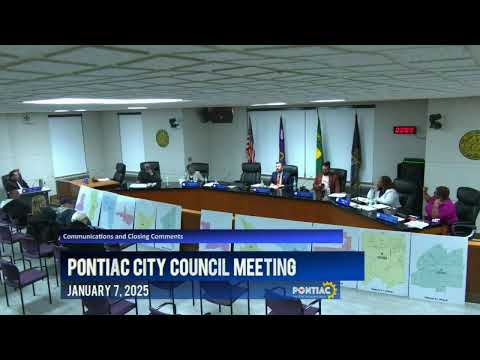
Pontiac’s City Council unanimously approved resolutions Jan. 7 to enter into a Michigan Department of Transportation construction agreement for traffic signal modernization and to contract Hubbell, Roth & Clark (HRC) for construction engineering and administration.
Lede detail: The project includes upgrades at seven intersections — Montcalm Avenue at Lakeside and Saginaw, MLK Boulevard at Victory and Balboa, Baldwin at Woodlake Lane, and multiple locations on State Street — plus removal of an unsafe pedestrian bridge and installation of ADA ramps, high‑visibility crosswalk markings, new mast‑arm signals and pedestrian countdown devices. On State Street the project converts a three‑block stretch from four travel lanes to three with a two‑way left‑turn lane and bike lanes.
Why it matters: The work is funded primarily through MDOT with a 90/10 cost split; the low construction bid was $1,799,403.12 and the city’s construction share was quoted at about $197,934.34 for that portion of the work. Engineering and administration will be performed by HRC under a separate contract. Council members said the project targets intersections with crash histories and will improve pedestrian and bicycle safety.
Acting City Engineer Zach (last name not provided) said MDOT awarded funds after a 2021 application and the project’s design focused on visibility, pedestrian safety and multimodal access. “The new proposed road diet will actually shift that. You will only have 1 lane going northwest… It will also help oncoming traffic from the south turning left to go to the east there,” he said, describing the State Street conversion.
Crash data presented to council showed recurring angle and head‑on collisions at the targeted intersections and at least one fatality during the 2018‑2020 review window. The engineer cited published outcomes from other agencies indicating lane reductions and signal upgrades can reduce total crashes by up to 47%, head‑on/side‑swipe collisions by about 40% and pedestrian‑involved crashes by approximately 30%.
Construction timing and impact: The city expects a spring construction start after a preconstruction meeting; the project includes video detection systems, reflectorized back plates on signals, steel mast arms (to replace overhead wiring), and high‑emphasis crosswalk markings. The State Street lane diet will create bicycle lanes on both sides of the route; the engineer noted the conversion is significantly less costly than widening the corridor to add lanes.
Council action: The council voted unanimously to authorize the MDOT agreement and the HRC engineering contract; Clerk Doyle recorded the roll call as 7–0.
Ending: Council thanked the engineer for the presentation and congratulated him on a funded design. Council members also asked administration for a multi‑year project list and future grant applications to address other streets where residents have requested improvements.