Get Full Government Meeting Transcripts, Videos, & Alerts Forever!
Get email alerts on the Redistricting topic
No spam. Unsubscribe anytime.
Pontiac council adopts new six‑district map after public hearing; some residents urge further tweaks
Summary
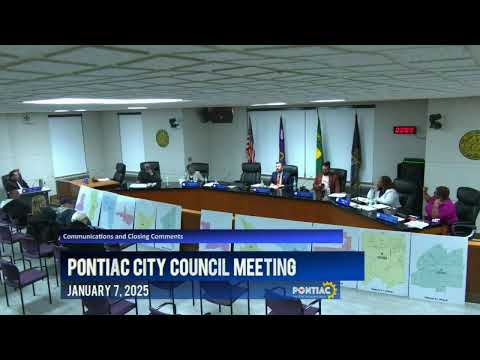
After a three‑month outreach campaign and a public hearing with dozens of speakers, the Pontiac City Council voted 5–2 Jan. 7 to adopt “Proposal A,” redrawing council districts from seven to six ahead of the 2025 filing season.
The Pontiac City Council voted 5–2 on Jan. 7 to adopt “Proposal A,” a new six‑district map that will replace the city’s seven‑district layout ahead of the 2025 election cycle.
Why it matters: The charter change voters approved in 2024 required the city to redraw council boundaries; the council must complete that work in time for candidates to collect nominating petitions and for the clerk’s office to update precincts and voter cards. Council members and dozens of residents argued over whether to adopt a map now or to seek a compromise “Proposal C” based on public feedback.
Council President Mike McGinnis opened the hearing by explaining the schedule and the legal standards the map must meet, saying the city’s map maker had produced two final proposals after earlier rounds of public input. “We are going to hold our 3rd public hearing during the council for you to be able to weigh in with questions, with feedback,” McGinnis said. The hearing drew residents from across the city; public commenters raised concerns about preserving communities of interest, access to federal funding and the perceived loss or gain of neighborhood representation.
Tamika Brown, a longtime resident, told council members she felt residents had not been engaged early enough and that the mapmaker had worked without adequate neighborhood input: “I feel that residents weren't given an opportunity to claim their communities of interest,” she said. Multiple speakers from the city’s east side urged keeping that area intact; others from District 1 told council members Proposal A was the least disruptive for their neighborhoods.
Clerk Doyle told the hearing that the charter’s legal deadline effectively requires lines to be in place before April to allow the clerk’s office time to update precincts and for candidates to collect signatures: “At minimum, we would need, like, probably 6 weeks… Preferably, I would like to have 2 months to do this,” Doyle said, calling attention to the practical constraints on timing.
Council debate focused on two options. Some members, including Councilman Carlton Jones and Councilwoman Kathleen James, said they wanted more time and a new combined “C” plan incorporating favored pieces of both proposals. Others, notably Councilman William Carrington and McGinnis, argued the council should act now to provide certainty for the clerk and prospective candidates. Carrington said repeated delays risked pushing critical election tasks into a prohibitive timetable.
On the motion to amend the ordinance to adopt Proposal A as the adopted plan (an amendment to the main ordinance), the council voted 4–3 to add language selecting Proposal A for the ordinance. On the final ordinance to establish the revised six districts using Proposal A, the roll call was: Parker — yes; Rutherford — yes; Carrington — yes; Goodman — no; James — no; Jones — yes; McGinnis — yes. The ordinance passed 5–2.
What happens next: Clerk Doyle said the office will mail updated voter cards and reconfigure precinct boundaries once the map is final; he warned that many election tasks must be completed before filing deadlines in April. He also stressed that population figures cited under each proposed district reflect total census population (not registered voters), and that redistricting will not change property zoning or census‑tract eligibility for federal programs such as CDBG.
Council members promised continued outreach and education after the vote so residents understand their new districts. McGinnis said the council would keep communicating the steps voters will see as the implementation proceeds.
Votes at a glance: Amendment to specify Proposal A in the ordinance — passed (4–3). Final ordinance adopting six districts (map A) — passed (5–2).
Ending: Council members and residents who pressed for further tweaks said they would keep asking for updates; the clerk and council urged anyone thinking of running for office this year to begin preparation now because the filing timetable is approaching.