Get Full Government Meeting Transcripts, Videos, & Alerts Forever!
Get email alerts on the Parking Enforcement topic
No spam. Unsubscribe anytime.
Resident attorney urges Dickinson to enforce zoning after years of vehicles, oil and blocked driveways on First Street East
Summary
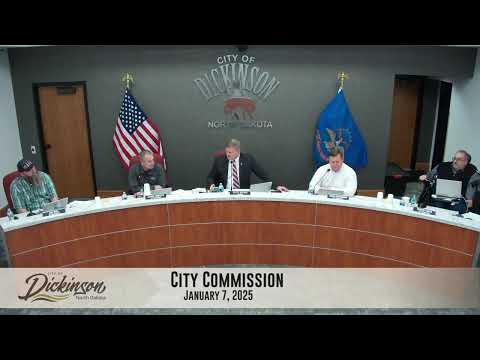
Attorney Sandra Kuntz pressed the Dickinson City Commission on Tuesday to enforce the city’s commercial zoning and nuisance ordinances at the 900 block of First Street East, saying repeated parking, oil deposits and what she described as daily outdoor storage by a nearby auto-repair business have persisted for “the better part of a decade.”
Attorney Sandra Kuntz pressed the Dickinson City Commission on Tuesday to enforce the city’s commercial zoning and nuisance ordinances at the 900 block of First Street East, saying repeated parking, oil deposits and what she described as daily outdoor storage by a nearby auto-repair business have persisted for “the better part of a decade.”
Kuntz, representing property owner Anthony Kleinmachter, told the commission the city’s supplemental-use rule (section 3906) requires outdoor storage tied to auto repair to be “completely screened as to not be visible from residential areas or public rights of way,” and that a blanket application of the city’s 48-hour rule for parked vehicles has been used to evade that requirement.
“Your ordinance says outdoor storage must be in the four corners of your lot and not visible to the public right-of-way,” Kuntz said. “We are asking that you change and clarify that the interpretation of the 48‑hour parking provision is not available to skirt the requirements of the outdoor-storage rules.”
Deputy Chief Hansen of the Dickinson Police Department confirmed officers have recorded repeated calls for service to the block and that the department issued at least one parking citation in the last year. “I believe it’s 17 calls for service in 2024,” Hansen said. He said officers and staff have pursued options beyond citations, including conversations with Schmidt Transmission, the business at issue.
Remington Schmidt, who identified himself as the business owner, told the commission that most vehicles parked on the street are operable and are typically moved into the shop during business hours. “When we do open, it’s immediately brought in and the spill is cleaned up,” Schmidt said. He said his shop is working to expand on‑site capacity and to reduce the number of vehicles left on the street.
Kleinmachter, the resident who filed the complaint, said the situation is often worse than a handful of cars: “It’s not about three or five vehicles. It’s 10, 15, 20. I’ve seen a personal best of 27 vehicles on the street,” he told the commissioners, adding that leaking oil and blocked driveways have made entry and garbage pickup difficult.
City staff, including Building Official Schwint and code enforcement, told the commission the term “storage” is not precisely defined in the municipal code and that practical distinctions — for example, vehicles parked overnight versus vehicles in for immediate service — affect enforcement. Schwint said the city typically treats private-property storage as becoming a code issue after 72 hours; the public‑street marking and 48‑hour tire‑mark practice affects how calls are handled.
Commissioners and staff described recent steps: engineering, public-works and code-enforcement visits, installation of security cameras that city staff can access, and the purchase of a street sweeper by the business. Deputy Chief Hansen said the city attempted mediation earlier but that the property owner declined.
Rather than take immediate enforcement action at Tuesday’s meeting, the commission directed staff to convene a meeting with the parties — city code, public works, police, the property owner and the business — and return with recommended options for addressing the conflict, ranging from clearer ordinance language to enforcement approaches. The commission did not vote on an ordinance change at the meeting.
The issue illustrates a gap staff flagged: the city’s supplemental-use language anticipates outdoor storage be screened and confined to private property, but day-to-day enforcement relies on a mix of parking rules, call-response practices and available resources. Kuntz urged the commission to “follow your own ordinances” and consider clarifying language that would bar the 48‑hour tire‑mark practice from being used to permit long-term carriage of vehicles on public rights-of-way.
The commission’s next step, as stated on the record, is for commissioners and city staff to meet with the affected parties and return with a written recommendation on clarifying interpretation or pursuing direct enforcement, or both.