Get Full Government Meeting Transcripts, Videos, & Alerts Forever!
Get email alerts on the Renewable Energy Policy topic
No spam. Unsubscribe anytime.
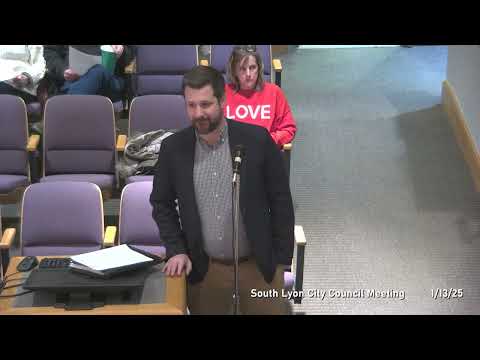
South Lyon council directs staff to develop ordinance focusing on battery storage under Public Act 233
Summary
City council discussed Michigan’s Public Act 233 (the Clean and Renewable Energy Reduction Act) and gave staff direction to gather focused information on battery energy storage systems, with a preference for a “workable” local ordinance that would limit impacts on the city.
South Lyon City Council discussed Public Act 233, the Clean and Renewable Energy Reduction Act, and asked staff to prepare focused guidance and a draft ordinance that would concentrate on battery energy storage systems.
City Attorney Kristen, who presented memos and an attorney-client privileged communication, said, "This act ... gives local governments the opportunity to adopt ordinances to regulate wind, solar, and battery storage energy facilities." Planner Hannah added that the city has draft ordinances that mirror the state act and alternate templates for larger- and smaller-scale systems.
Council members repeatedly said large solar farms and wind installations are unlikely inside South Lyon because of limited undeveloped land and the city’s lack of nearby high-voltage transmission lines. Several members nonetheless expressed concern about battery energy storage systems because of fire and thermal-runaway risks. Mayor and multiple councilmembers emphasized safety setbacks and operational controls as priorities if the city adopts local rules.
Kristen and Hannah told council there are two basic local approaches: adopt a CREO (compatible renewable energy ordinance) that conforms to PA 233 or adopt a workable non‑CREO ordinance that can be stricter but could prompt a developer to instead pursue state approval. Hannah said some communities in the region — including Groveland Township and the City of Wixom — have begun drafting or adopting ordinances.
Councilmember Hanson, citing a recent EGLE seminar he attended with other councilmembers, said a local CREO can speed and keep decisions local. Councilmember Doak, Councilmember Kurzweil and others said they favored having a workable ordinance that would give the city more control over siting and safety, especially for battery systems. Councilmember Kibble and others asked for targeted information about battery‑specific risks, emergency response, and insurance implications.
City Manager Paul Zelnick said staff would compile the requested materials, including the attorney memo, examples of local ordinances (Groveland, Wixom drafts), and battery‑specific background, and return the matter to council for further discussion. Kristen and Hannah also offered to share the drafts they have prepared.
No formal ordinance was adopted at the meeting. The council’s direction was to: (1) prioritize drafting a workable ordinance addressing battery storage systems; (2) circulate focused battery safety and risk information to all councilmembers; and (3) review sample ordinances from nearby jurisdictions before returning the item for further action.