Get Full Government Meeting Transcripts, Videos, & Alerts Forever!
Get email alerts on the Capital Budgeting topic
No spam. Unsubscribe anytime.
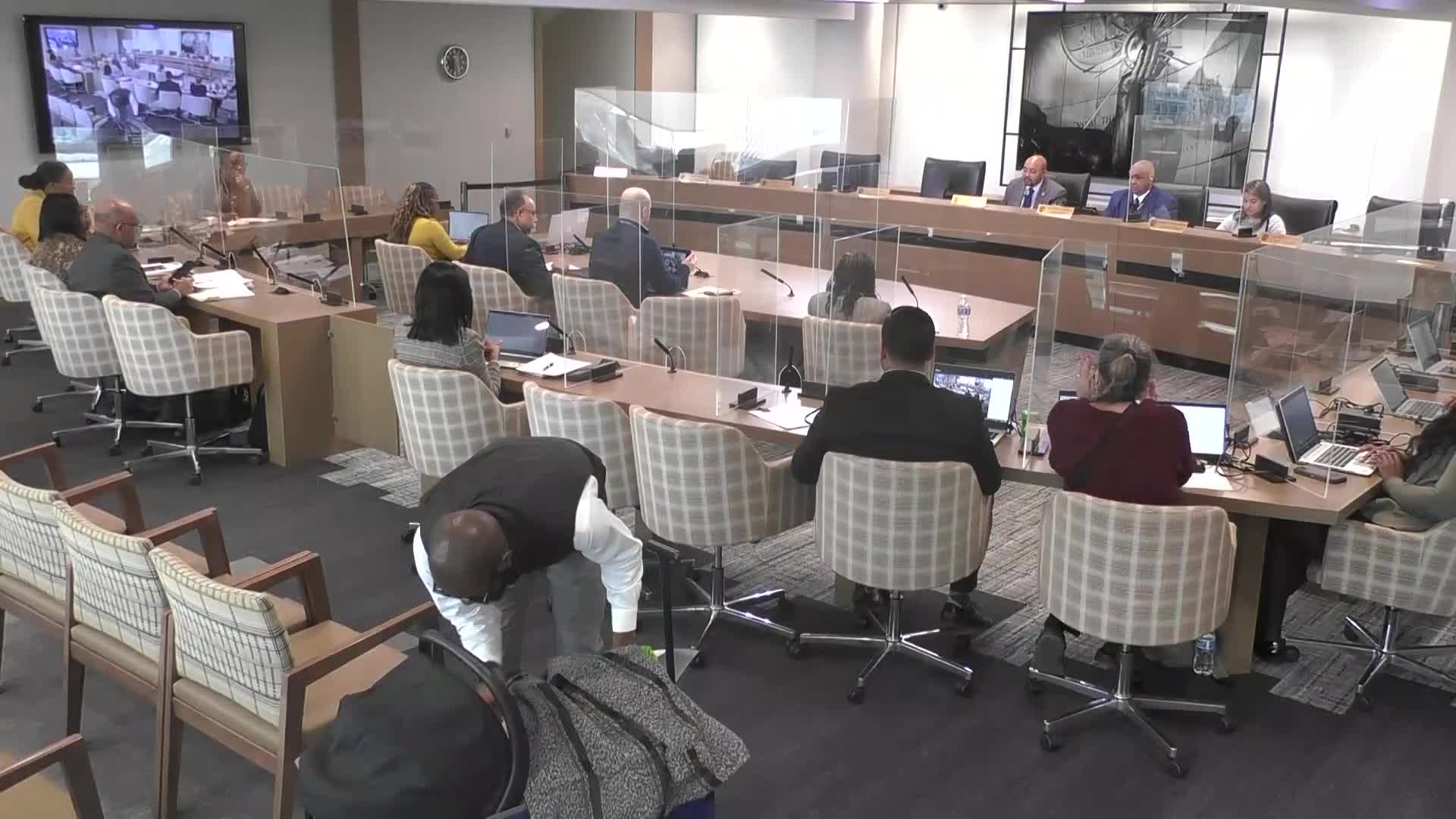
Detroit committee opens public hearing on $2.4 billion proposed five‑year capital agenda
Summary
The Budget, Finance & Audit Standing Committee of the Detroit City Council on Jan. 9 opened a charter‑mandated public hearing on the city’s proposed five‑year capital agenda, a planning document that lays out potential projects and funding sources but does not appropriate money.
The Budget, Finance & Audit Standing Committee of the Detroit City Council on Jan. 9 opened a charter‑mandated public hearing on the city’s proposed five‑year capital agenda, a planning document that lays out potential projects and funding sources but does not appropriate money. Deputy Budget Director Donnie Johnson and City Planning Commission Director Marcel Todd presented the outline and told the committee the document is intended to inform grant seeking, budgeting and long‑range planning.
The proposed capital agenda is a five‑year planning document that Johnson said “is not a budget. It does not appropriate money,” and that it compiles candidate projects and potential funding sources for infrastructure, housing, parks, transportation, technology and city facilities. The plan presented to the committee lists $2,400,000,000 in capital planning across a range of categories and potential funders.
Why it matters: The capital agenda sets priorities that guide which projects the administration pursues for grant applications and budget requests. While the agenda does not allocate funds, projects listed and the priorities set in the document shape future appropriations, grant applications and procurement decisions.
Key details from the presentation
- Housing and economic development: Johnson said the agenda anticipates $131,000,000 already allocated in the current fiscal year and an additional $108,000,000 planned for FY26–FY30; he described a broader expectation of roughly $204,000,000 in affordable housing development across the period, including more than $117,000,000 already underway or completed and $12,000,000 for neighborhood framework plans and $2,000,000 for a master plan update.
- Open space and recreation: The agenda shows about $309,000,000 already allocated and an additional $355,000,000 planned for parks and recreation improvements. Joe Louis Greenway construction appears in the list with $116,000,000 already allocated and $124,000,000 planned for future phases.
- Health and public safety: The document lists $66,000,000 currently allocated with $88,000,000 planned; Johnson said $53,000,000 is targeted to state‑of‑good‑repair work and modernization for Detroit fire facilities.
- Police facilities and fleet: The plan anticipates roughly $94,000,000 for police facility improvements with about $41,000,000 already underway; the agenda also lists ongoing investments in fleet replacement and low/zero‑emission vehicles.
- Transportation and airport: Transportation spending in the plan includes $365,000,000 already allocated and $651,000,000 planned. Johnson noted $40,000,000 in expected funding for construction of a new air‑traffic control tower at Coleman A. Young International Airport and continued investment in DDOT fleet modernization and low‑emission buses.
- Government infrastructure and utilities: The presentation described $435,000,000 already allocated for government infrastructure with an additional $1,100,000,000 planned. The Detroit Water and Sewerage Department’s planned investments are listed at $762,000,000; the Public Lighting Authority projects $24,000,000 in corridor lighting upgrades.
Funding sources and limits: Johnson and Todd repeatedly emphasized the agenda is nonbinding and that figures are planning estimates; many items depend on federal, state or philanthropic funding (Johnson cited HUD, MSHDA, Act 51 formula funds and ARPA). Todd said the public hearing exists to gather public comment and to prompt council offices and the Planning Director to respond with detailed recommendations.
Committee action and next steps: Committee members voted to request formal recommendations from Planning Director Marcel Todd and staff; the committee directed the Legislative Policy Division and CPC staff to prepare a resolution submitting council questions to the planning director and to return the item to the committee for formal action after the Planning Director’s responses. Johnson and Todd said the City Planning Commission will review and submit its recommendation and that LPD will issue fiscal and policy reviews.
Public engagement and comment channels: Johnson said the administration is accepting written public feedback at yourbudget@detroitmi.gov and noted public comments received during the hearing will be considered. Todd said copies of the proposed capital agenda are available on the city website and at legislative policy and planning offices and the main library.
Quotes
- “It is very important to stress … that this is not a budget. It does not appropriate money,” Deputy Budget Director Donnie Johnson said, describing the agenda as a planning document that helps prioritize grant seeking and infrastructure needs.
- “The public hearing … is intended to facilitate the public’s opportunity to comment on the document,” City Planning Commission Director Marcel Todd said when describing the procedural steps that follow the charter‑required hearing.
Ending: The committee will collect written questions and recommendations from council offices, LPD and CPC staff and expects Planning Director responses in the coming weeks; the capital agenda will return to the full council for further deliberation and final approval.