Get Full Government Meeting Transcripts, Videos, & Alerts Forever!
Get email alerts on the Vacant Lot Registration topic
No spam. Unsubscribe anytime.
North Port commission directs staff to develop unimproved‑lot registration program to speed tree, vegetation abatement
Summary
The City Commission voted to direct staff to draft an unimproved‑lot registration program to speed removal of hazardous trees and invasive vegetation after hearing staff say the city receives dozens of vegetation complaints each week and that prior abatement efforts produced low lien recoveries.
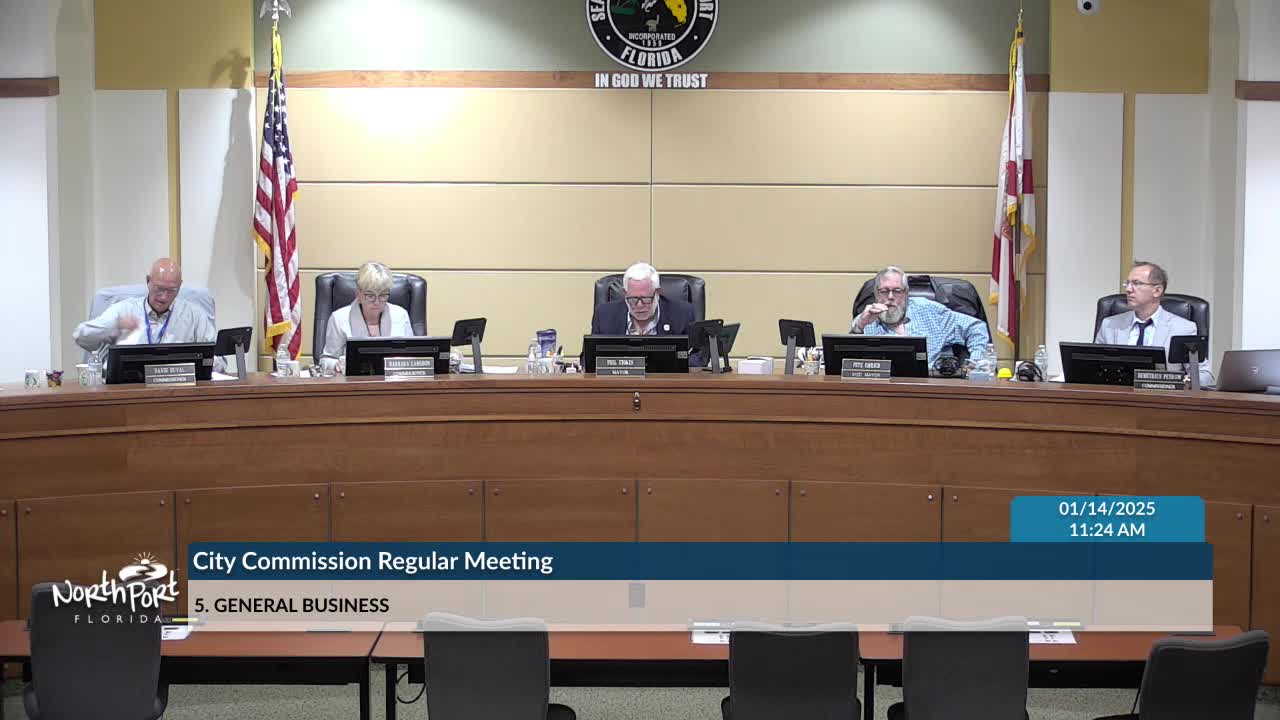
The City Commission of North Port voted to direct the city manager to develop an unimproved‑lot registration program aimed at speeding removal of hazardous trees and invasive vegetation on vacant parcels and providing a dedicated funding stream for abatement. The motion, made by Commissioner Langdon and seconded by Vice Mayor Emerich, passed 4–1 with Commissioner Duvall opposed.
Commissioners directed staff to return draft ordinance language and implementation options that would: establish annual registration for unimproved parcels; define exemptions for conservation lands, government property and adjacent‑owner maintained lots; evaluate fee mechanisms (including a non‑ad valorem assessment); and further specify how “impinging growth” and fire‑risk vegetation would be qualified and addressed.
The directive follows a presentation by Elena Ray, director of Development Services, who framed the problem as growing and costly. Ray told commissioners the city has “around 40,000 vacant lots” and currently receives roughly 35 calls a week about vegetation encroaching on neighbors and about 15 hazardous‑tree calls each week. She said the program would “collect current property owner information and emergency contact” and could be implemented either via an online annual registration portal or through a non‑ad valorem assessment; Ray said many comparable programs nationwide use non‑ad valorem collections to reduce ongoing administrative enforcement costs.
Ray cited historic experience: North Port ran an impinging‑growth program from 2017–2020 that led to about $570,000 in abatement costs and more than 300 liens; she said roughly 270 of those liens remain outstanding and that the city’s lien recovery rate is about 30%. She said the city’s current code‑enforcement budget includes approximately $60,000 a year for tree removal and that a single pine can cost roughly $1,000 to fell (and another $300–$500 to remove if hauling off‑site).
On likely fee ranges Ray said cities she reviewed charge between $100 and $500 annually; a $100 annual fee on North Port’s roughly 40,000 unimproved parcels would hypothetically generate about $4,000,000 a year. She explained the fee pot would operate like an insurance pool: abatement and contracted removal would be paid from a collective fund rather than billing each lot owner for specific removal costs.
Public safety and practical impacts figured heavily in the discussion. Fire Rescue Chief Scott Titus said the program would reduce risk from trees and accumulated vegetative “fire load,” adding that “when those trees catch on fire…they create widowmakers,” and that reducing hazardous trees adjacent to homes and rights‑of‑way helps response and mitigation. Ray said program funds could be used for abatement (targeting invasive species such as Brazilian pepper and aggressive vines), natural‑resources review before removal (to avoid harming protected species or habitat), and targeted infrastructure improvements (for underserved pre‑platted lots) if revenues exceeded enforcement needs.
Commissioners and public commenters split on trade‑offs. Commissioner Langdon said she was “very supportive” but wanted to limit use of any excess funds to priorities tied to the program’s purpose; she favored starting with a modest fee and scaling. Vice Mayor Emerich and Commissioner Petro both supported moving the program forward; Petro pressed on projected costs and impacts on investors who own many lots. Commissioner Duvall opposed the motion, citing fairness concerns for property owners who already maintain unimproved lots and suggesting the city consider broader tax funding rather than a fee targeted only to lot owners.
Members of the public raised complementary concerns: Robin Sam Vicente asked how the program would protect environmentally sensitive parcels and requested transparent public reporting and criteria for exemptions; real estate investor Al Pykesh cautioned that added annual costs would pressure small investors and could prompt lot liquidation or reduced private maintenance; other callers noted problems with illegal dumping on vacant lots.
The motion passed with these directives: staff should continue drafting the program, model a $100/year illustrative fee but present alternatives, evaluate non‑ad valorem collection, create clear exemptions (including for lots actively maintained by adjacent owners or held in conservation), define invasive‑growth and fire‑risk qualification criteria, and propose governance and reporting for fund use. The commission did not adopt an ordinance or set a final fee at this meeting; staff will bring draft ordinance language, cost estimates, and implementation scenarios back to the commission for further action and public hearings.
What commissioners will see next: draft ordinance language implementing registration and collection options; an analysis of projected annual revenues and estimated program costs (staffing, contractor abatement, and natural‑resource review); proposed exemption forms and processing rules; and proposed reporting requirements for the fund.
Speakers (attribution whitelist)
- Elena Ray, Director, Development Services, City of North Port - Scott Titus, Fire Rescue Chief, City of North Port Fire Rescue - Brian Fletcher, City Manager, City of North Port - Stacie (Elena) Grama/Sherry Wollack Grama, Planning & Zoning staff (appeared earlier in meeting as planning staff) - Mayor Stokes - Vice Mayor Emerich - Commissioner Langdon (mover) - Commissioner Duvall (voted no) - Commissioner Petro - Robin Sam Vicente (public commenter) - Al Pykesh (public commenter)
Discussion_decision
{"discussion_points":["High volume of nuisance and hazardous vegetation complaints (35 impinging growth calls/week; 15 hazardous tree calls/week).","Historic program (2017–2020) cost $570,000 with low lien recovery (~30%).","Options for fee collection: online annual portal vs. non‑ad valorem assessment; cities generally prefer non‑ad valorem for administrative simplicity.","Exemption categories: conservation lands, government property, adjacent owner‑maintained lots, HOA/common areas.","Primary eligible abatement scope: invasive species (Brazilian pepper, fast‑growing vines), hazardous trees that threaten homes/right‑of‑way.","Possible program revenue scenarios (illustrative): $100/lot/year -> ~$4M gross annually (before exemptions).","Implementation requires additional code enforcement staff and multiple contractor vendors to perform abatement safely.","Natural resources review required pre‑abatement to protect protected species/habitat."],"directions":["City manager to have staff draft program materials and ordinance language for return to commission.","Include provision for non‑ad valorem assessment approach and an online fee option in the analysis.","Model fee scenarios (including $100/year illustrative), exemption forms and criteria, staffing needs, contractor procurement approach, and fund governance and reporting.","Return with estimates of annual program revenue and annual operating costs, including staffing and contractor costs."],"decisions":["Motion passed 4–1; commission directed staff to develop unimproved‑lot registration program and return with proposed ordinance language and financial analysis."]}
Clarifying_details
[{"category":"vacant_lot_count","detail":"City has around 40,000 unimproved vacant lots","value":40000,"units":"lots","approximate":true,"source_speaker":"Elena Ray"},{"category":"weekly_complaints_impinging_growth","detail":"Average calls about impinging growth","value":35,"units":"calls/week","approximate":true,"source_speaker":"Elena Ray"},{"category":"weekly_complaints_hazardous_trees","detail":"Average calls about hazardous trees","value":15,"units":"calls/week","approximate":true,"source_speaker":"Elena Ray"},{"category":"historical_abatement_costs","detail":"Cost of impinging growth program 2017–2020","value":570000,"units":"USD","approximate":false,"source_speaker":"Elena Ray"},{"category":"historic_liens","detail":"Liens filed during 2017–2020 program","value":300,"units":"liens","approximate":false,"source_speaker":"Elena Ray"},{"category":"outstanding_liens","detail":"Liens still outstanding from prior program","value":270,"units":"liens","approximate":false,"source_speaker":"Elena Ray"},{"category":"lien_recovery_rate","detail":"City’s average recovery rate on abatement liens","value":0.30,"units":"fraction","approximate":false,"source_speaker":"Elena Ray"},{"category":"tree_removal_cost_on_site","detail":"Estimated cost to fell a pine and leave on site","value":1000,"units":"USD","approximate":true,"source_speaker":"Elena Ray"},{"category":"tree_removal_cost_remove_offsite","detail":"Estimated added cost to remove tree from lot","value":400,"units":"USD","approximate":true,"source_speaker":"Elena Ray"},{"category":"current_code_enforcement_tree_budget","detail":"City code enforcement line for tree removal per year","value":60000,"units":"USD","approximate":false,"source_speaker":"Elena Ray"},{"category":"fee_example_low","detail":"Example low fee cited from other cities","value":100,"units":"USD/year","approximate":false,"source_speaker":"Elena Ray"},{"category":"fee_example_high","detail":"Example high fee cited from other cities","value":500,"units":"USD/year","approximate":false,"source_speaker":"Elena Ray"},{"category":"illustrative_revenue_at_100","detail":"Illustrative revenue at $100/year across 40,000 lots","value":4000000,"units":"USD/year","approximate":true,"source_speaker":"Elena Ray"},{"category":"estimated_full_program_cost_range","detail":"Staff estimate range to fully address tree and enforcement needs, including staffing","value":"1,000,000-1,500,000","units":"USD/year","approximate":true,"source_speaker":"Elena Ray"}]
proper_names
[{"name":"City of North Port","type":"agency"},{"name":"Development Services Division","type":"agency"},{"name":"Fire Rescue","type":"agency"},{"name":"Brazilian pepper","type":"other"},{"name":"Legacy Trail","type":"program"}]
community_relevance
{"geographies":["City of North Port"],"funding_sources":["non‑ad valorem assessment (proposed)","general fund (current)","grant funding (potential)"] ,"impact_groups":["adjacent homeowners","unimproved lot owners","small investors","first responders"]}
meeting_context
{"engagement_level":{"speakers_count":20,"duration_minutes":210,"items_count":1},"implementation_risk":"medium","history":[{"date":"2017-01-01","note":"Previous impinging growth program (2017–2020) — resulted in $570,000 abatement cost"}]}