Get Full Government Meeting Transcripts, Videos, & Alerts Forever!
Get email alerts on the Fiscal Study topic
No spam. Unsubscribe anytime.
PFM study: New land-use rules could add jobs, revenue to North Port but market adoption uncertain
Summary
Consultants told the North Port City Commission an updated Unified Land Development Code (ULDC) could substantially increase population, jobs and taxable value over 30 years, producing positive net fiscal impacts — but officials were repeatedly warned the timing of that market response is uncertain.
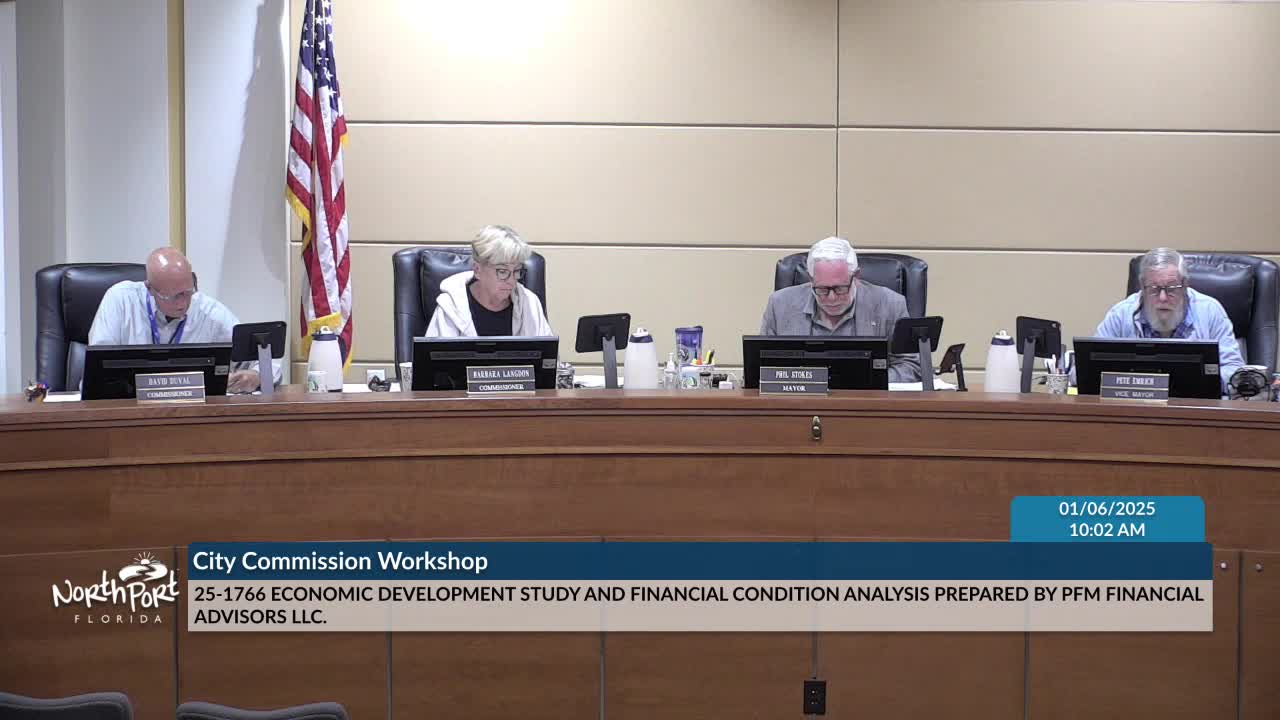
Consultants from PFM Financial Advisors presented a fiscal- and economic-impact analysis to the North Port City Commission on Monday, saying changes to the city’s Unified Land Development Code could generate substantial new population, employment and taxable value — but that those benefits depend on how quickly the market adopts the new rules.
The PFM team described three modeled scenarios: a “historic” scenario using the previous ULDC and roughly 3% annual population growth; a high-adoption updated-ULDC scenario with faster growth and a higher jobs-to-resident ratio; and a slower-adoption updated-ULDC scenario that assumes historical population growth but greater job density than the historic baseline. “The net fiscal impact is strongly positive across development scenarios,” PFM presenter Mallory Richards said during the presentation.
PFM said the updated-ULDC scenarios increase North Port’s residential and nonresidential buildout relative to the historic model. The consultants reported that North Port currently has about 40,000 residential units and roughly 5 million square feet of nonresidential space; under the updated-ULDC scenarios, multifamily development would gradually take a larger share and nonresidential square footage could rise substantially to accommodate new jobs. PFM also showed projections that, depending on market response, additional revenue for the city could be “in excess of $70,000,000” in 2035 from property taxes and district fees tied to development schedules.
PFM explained key modeling assumptions during the workshop. The team said it used a per-capita approach for many operating revenues and expenditures and direct estimation for property-tax and district-fee revenue. Among model inputs: a 1.5% annual growth in market value used as a forecast plug for taxable value and an assumption that the city’s millage rate remains unchanged for forecasting purposes. Garrett Hinken of PFM noted technical limits in the presentation software but reiterated the methodology and assumptions.
Commissioners and staff focused discussion on timing, infrastructure needs and how the model will be used. PFM and city staff repeatedly cautioned that the model is a planning tool that should be updated annually or when major assumptions change. “From a planning perspective, you created the opportunity because you’re reducing the volume of single family lots ... but what you don’t know is how quickly that’s going to occur,” a PFM presenter said. Commissioners expressed that they expect a delayed market response and questioned how soon revenues would materialize for capital projects.
The PFM team also reviewed how additional revenues could support major capital needs. Presenters explained financing options — from pay-as-you-go to general obligation bonds, sales surtax-backed bonds and public-private financing — and said the model can be updated to test alternative funding packages as the city finalizes its capital improvement plan. City staff and PFM said the model is calibrated to the city’s most recent annual financials and is intended to be a living tool that staff can update as budgeting and development data arrive.
The presentation closed with commissioners asking for continued access to the model and for staff to return with related capital-improvement studies. PFM said it would include more detailed sector-level employment and wage breakdowns in the final report.
Why this matters: North Port officials are using the fiscal analysis to ground policy decisions about infrastructure and public-safety facilities. The magnitude and timing of revenue growth will affect whether projects are funded from existing reserves, new bonds, surtax allocations or other sources.