Get Full Government Meeting Transcripts, Videos, & Alerts Forever!
Get email alerts on the Board Policy topic
No spam. Unsubscribe anytime.
Trustees discuss changes to meeting conduct bylaw and consider a safe‑haven resolution for students
Summary
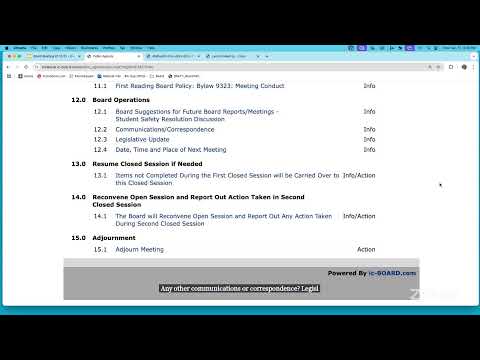
During a first reading of proposed amendments to Board Bylaw 9323, trustees debated reducing per‑item public comment time from 30 to 20 minutes and the board’s authority to clear disruptive meetings; they also signaled interest in drafting a resolution assuring protections for undocumented students.
Trustees discussed proposed amendments to Board Bylaw 9323 (Meeting Conduct) and considered drafting a resolution to reassure undocumented students and families at the Jan. 13 board meeting.
The proposed bylaw changes, presented as a first reading, update board authority to manage disruptive meetings — including measures such as asking individuals to leave and temporarily clearing a room with limited exceptions for the press — and propose a per‑item public comment time limit of 20 minutes. Trustees debated the proposed 20‑minute cap versus retaining the existing 30‑minute limit. Several trustees said they preferred to keep 30 minutes to preserve public participation; others raised that the California School Boards Association recommended the 20‑minute guideline. Trustees noted that, in practice, board presidents typically seek the board’s consensus to extend public comment when community interest is high.
Separately, trustees discussed whether to draft a public‑statement resolution signaling the district as a safe haven for students regardless of immigration status. Trustees said they had received community inquiries and noted that the district had already circulated guidance from legal counsel and the state attorney general about sensitive locations, subpoenas, warrants and protocols for law‑enforcement requests. Trustees expressed support for preparing a public resolution that reiterates the district’s duty under Plyler v. Doe (U.S. Supreme Court) to provide public education to students residing in the district and to clarify staff procedures for responding to law‑enforcement requests.
Why it matters: Changes to meeting conduct bylaws set the rules for public engagement at board meetings; a safe‑haven resolution would communicate district policy and procedures to vulnerable families and align local practice with state and federal legal guidance. Both items will return to the board for additional consideration and, where applicable, a vote.
Next steps: Because the bylaw changes were presented as a first reading, trustees will consider a second reading and potential vote at a future meeting. District attorneys and administrators will draft language for a student‑protections resolution and share counsel’s guidance with trustees prior to formal consideration.