Get Full Government Meeting Transcripts, Videos, & Alerts Forever!
Get email alerts on the Land Use Solar Policy topic
No spam. Unsubscribe anytime.
Consultant urges Patrick County to tighten solar policy, warns current ordinance may be vulnerable
Summary
The Berkeley Group briefed the Patrick County Board on draft comprehensive plan language and ordinance changes for utility‑scale solar, recommending the county rely on a detailed comprehensive-plan policy and 15.2‑2232 review rather than the current ordinance process.
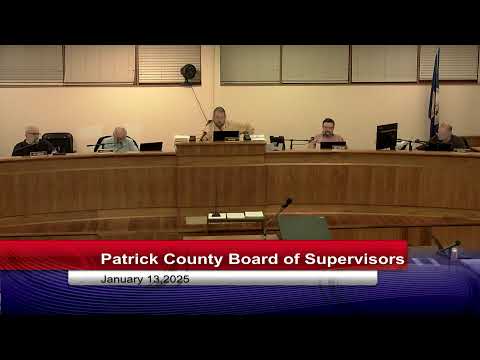
Michael Zayner, director of Planning and Community Development for the Berkeley Group, told the Patrick County Board of Supervisors that the county’s current ordinance and comprehensive plan leave it exposed on commercial solar siting and that stronger policy language is essential if the board wants to restrict utility‑scale projects.
“We don’t look at the plan by its length…we look at whether it is comprehensive and how much it ensures that projects that come before you are in keeping with the goals and objectives of the county,” Zayner said, describing draft revisions to the county’s comprehensive plan and ordinance intended to give the planning commission clear evaluation criteria under the 15.2‑2232 review process.
Zayner said Patrick County lacks zoning and therefore must rely on the 15.2‑2232 process, under which the planning commission reviews an application for consistency with the comprehensive plan and issues a report to the board. He said the county’s current ordinance describes a process that departs from the statute and should be corrected so the planning commission’s role and the appeal path are clear.
Board members and the consultant discussed options if the county’s majority opposes utility‑scale solar. Zayner said the Berkeley Group can draft policy language — and work with the county attorney — to make that preference defensible in review and, if necessary, litigation. He cautioned that the Virginia General Assembly is considering solar legislation that could affect local authority.
Board members discussed procedural next steps: adopting a resolution to initiate a comprehensive-plan amendment and directing the planning commission to work with the Berkeley Group and county attorney. Zayner also described typical distinctions between a policy (where to locate or forbid projects) placed in the comprehensive plan and an ordinance that specifies application content, objective standards and process.
What’s next: Staff and the planning commission are expected to continue work on draft comprehensive plan language and an ordinance aligned with state 15.2‑2232 review procedures; the board may consider a resolution to initiate a plan amendment.