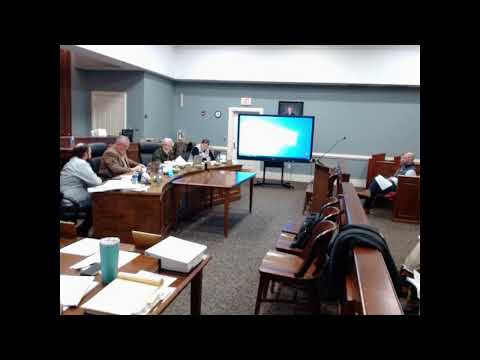
Nelson County approves Wild Rose solar project with 40-year limit and $230,000 annual voluntary payments
Loading...
Summary
After public comment split between support and opposition, the Nelson County Board of Supervisors approved a special use permit for the 90-megawatt Wild Rose (Savion) solar project and accepted a revised siting agreement that includes annual voluntary payments and a $10,000-per-year scholarship for the county's South District.
The Nelson County Board of Supervisors on Jan. 14 approved a special use permit for the Wild Rose utility-scale solar project and accepted a revised solar siting agreement that includes annual voluntary payments and a recurring scholarship for southern-district students.
The board approved the special use permit for a 90-megawatt solar facility that would place panels on about 470 acres of the applicant’s roughly 46,100-acre parcel and run for a 40-year operating life. The board attached language limiting the permit to the 40th anniversary of commercial operation, after which the permit expires unless the board votes to extend it.
The approval followed an extended public comment period in which residents testified both for and against the project. Supporters said the facility would reduce carbon emissions and supply needed power; some said the company’s payments and local rooftop-solar offers were helpful. Opponents raised concerns about erosion and stormwater control, the visual impact, the adequacy of local enforcement of special-use permits, potential litigation costs, and whether the project’s power would flow to nearby data centers rather than local users.
In accepting the revised siting agreement, county staff summarized changes to the payment schedule (Exhibit B of the agreement) that added a voluntary operational payment of $230,000 per year for 40 years (shown in the agreement as column E), which the county staff described as totaling $9,200,000. The agreement also adds an annual $10,000 scholarship fund for students from the county’s South District for 40 years (totaling $400,000). During the meeting a member of the public and at least one supervisor referenced a higher headline figure offered earlier in negotiations (approximately $20,000,000) as background to the revised package; staff said the revised Exhibit B and the tax-related payments required under state law are separate line items.
Eric Mjarka, a Savion representative, told the board the company had no knowledge of a recently announced Appomattox data center before public reports and that generators cannot sell directly to a single private data center because utilities control distribution. Mjarka described the siting agreements as standard practice in the Commonwealth and said voluntary payments are in addition to the tax payments required by state law.
County staff reminded the board that local zoning approval is only an early step. If the special use permit is approved, the project must proceed through the Virginia Department of Environmental Quality’s (DEQ) permit-by-rule process, which staff said will require that impacts be avoided, minimized or mitigated and that the state will perform additional reviews.
Board members debated several topics during discussion: whether a special use permit should run with the land or expire; erosion and stormwater control; the loss of farmland and viewscapes; the limited number of permanent local jobs from such projects; and concern that state policy changes could later remove local permitting authority. Multiple supervisors said they were reluctant to open the county to additional projects automatically and favored the permit-expiration language recommended by staff (40 years from commercial operation).
The board also voted to accept the siting agreement as presented at the meeting; the agreement incorporates the special use permit as an exhibit and spells out the payment schedule and scholarship terms. The siting agreement language indicates the scholarship may be awarded to one or more students and that selection is at the discretion of the county and the project owner or their designee; the board discussed but did not finalize selection details during the meeting.
The board additionally noted the planning commission had made a prior determination related to comprehensive-plan consistency; by approving the special use permit, the board effectively overturned that planning-commission determination.
The project approval is subject to the DEQ permitting process and the specific conditions set in the special use permit and the siting agreement. Supervisors asked staff to continue oversight of permit compliance and flagged the county’s limited in-house enforcement capacity for special use conditions as an ongoing concern.
Votes at a glance - Special Use Permit (24-0014), Wild Rose Solar Project: motion approved; recorded roll-call responses in the transcript include Supervisor Leighton — Yes; Supervisor Rutherford — No; Supervisor Barr — Yes; Supervisor Reagan — Yes; additional recorded Yes responses also appear in the transcript; board outcome: approved. (Motion and second recorded on Jan. 14, 2025.) - Siting agreement (Wild Rose Solar Project, revised Exhibit B and scholarship): motion approved; recorded roll-call responses include Doctor Lee — Yes; Supervisor Rutherford — No; Supervisor Parr — Yes; Supervisor Reid — Yes; board outcome: approved.
Why it matters The decision allows a 90-megawatt, utility-scale solar project to move forward in Nelson County subject to state environmental review and the conditions in the county’s special use permit and siting agreement. The board created a time-limited local approval mechanism (permit expiry tied to 40 years of commercial operation) and secured a multi-decade payment and scholarship commitment the county can use for local priorities.
What’s next If the developer pursues the project, it must complete DEQ’s permit-by-rule process, demonstrate compliance with local permit conditions and implement required erosion and stormwater controls. County officials said they will continue to develop the scholarship-selection process and to monitor compliance through the permit and agreement terms.