Get Full Government Meeting Transcripts, Videos, & Alerts Forever!
Get email alerts on the Curriculum And Instruction topic
No spam. Unsubscribe anytime.
Mount Lebanon board reviews package of 10 curriculum and instruction policies, keeps adoption timetable
Summary
The Mount Lebanon Board of School Directors on Jan. 13 reviewed a package of 10 proposed policies governing curriculum and instruction and was told the policy committee intends to move the policies forward for approval after a one-week review period.
The Mount Lebanon Board of School Directors on Jan. 13 reviewed a package of 10 proposed policies covering curriculum and instruction and was told the policy committee recommends moving the policies forward for approval after a one-week review period.
The policies discussed include Policy 102 (Academic Standards); Policy 105 (Curriculum); Policy 105.1 (Review of Instructional Materials by Parents, Guardians, and Students); Policy 105.2 (Exemption from Instruction); Policy 107 (Adoption of Planned Instruction); a textbook-adoption policy (listed in materials as Adoption of Textbooks, replacing IJ Selection of Instructional Materials); Policy 109 (Noncurricular and Resource Materials); Policy 110 (Instructional Supplies); a new lesson-plans policy; and Policy 119 (Current Events). Dr. David Friese, the superintendent, said the policies were reviewed earlier by the district’s policy committee and the committee’s slide deck has been posted in BoardDocs for public review.
The proposed Policy 102 would align district curriculum with the Pennsylvania Core Standards the State Board of Education adopts. Policy 105 would consolidate curriculum responsibilities and formalize the district’s K–12 curriculum council as the body to evaluate, develop and modify curriculum on a continuing basis; the superintendent or designee is designated as responsible for development and oversight. Policy 105.1 would make explicit that parents, guardians and students may request access to instructional materials, including academic standards and assessment techniques, and that the superintendent or designee shall provide an annual notice about that review right.
Policy 105.2 would allow parents and guardians to request that students be excused from specific instruction that conflicts with religious or moral beliefs; the policy text limits the right to parents/guardians of students under 18 and to students themselves when age 18 or older. Policy 107 would require the district to provide a comprehensive program of planned instruction and says the district will use an Understanding by Design framework when developing curriculum; the superintendent or designee is responsible for continuous evaluation and for recommending new or altered planned instruction to the board.
The textbook and resource-materials policies restate that the superintendent will recommend selections for board consideration and that no textbook or material adoption or change approved by the superintendent would be reversed except by a two‑thirds vote of the full board. Policy 110 would make explicit that the board shall supply staff and students with instructional supplies necessary to implement the approved educational program, while also permitting the district to require students to provide certain specialized, nonreusable items (for example, safety gear) and providing that the district will assume costs when required supplies impose a financial hardship.
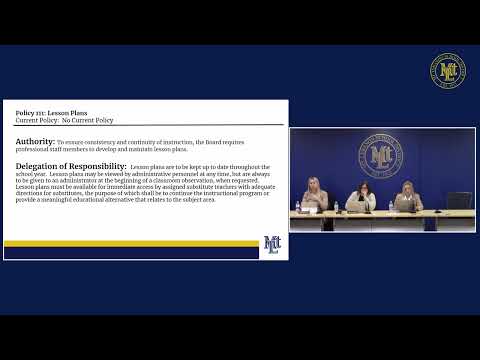
Board members asked for examples of “instructional supplies,” and Friese replied that items could range from devices such as district-provided laptops to course-specific tools like graphing calculators; he said the policy intentionally leaves detailed handling to administrative regulations so the district can address course‑specific needs case by case while guarding privacy and avoiding denial of participation for financial reasons. On lesson plans, the new language would require professional staff to maintain plans that are available for administrative review and accessible to substitutes.
Policy 119 would permit the instructional use of current events when material is tied to course goals, appropriate to students’ maturity, and presented in a balanced, scholarly manner that does not tend to indoctrinate or persuade students to a particular point of view. The superintendent noted that administrative regulations may be developed to manage the implementation of the current‑events policy.
Friese said the policies and the policy-committee slide deck are posted in BoardDocs and invited board members and the public to review the proposed language; he asked that questions be sent to district staff (Miss Guth) during the week before the board moves the items forward for approval and the retirement of two existing policies.
The board did not take a formal vote during the Jan. 13 meeting; the superintendent recommended approval of the package and said the materials will be brought forward for formal action after the review period.