Get Full Government Meeting Transcripts, Videos, & Alerts Forever!
Get email alerts on the Cannabis Policy topic
No spam. Unsubscribe anytime.
Lake County task force advances cannabis ordinance updates amid heated debate over farmland protections
Summary
County planners summarized a broad set of Cannabis Ordinance Task Force recommendations, from abandoned-application rules and recordkeeping to setbacks, farmer protections and a proposed expansion of a farmland protection zone that drew strong public comment from growers and neighbors.
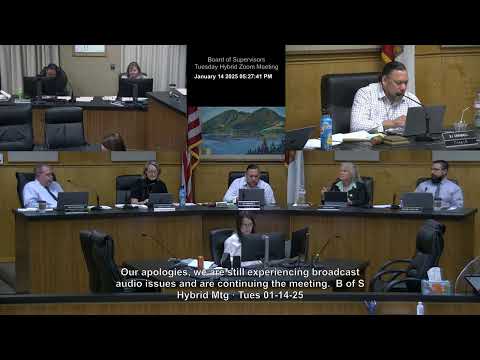
Community Development Director Mireya Turner told the Board of Supervisors that the Cannabis Ordinance Task Force has continued work on a package of changes to local cannabis rules, and she presented the group’s remaining topics for discussion.
“The original goal had been to get a draft ordinance updating or making recommendations for updating cannabis policy by the end of this last year,” Turner said. Senior planner Mary Clabaugh followed with a staff summary of outstanding items, and task force members and dozens of public commenters spoke for and against several recommendations.
Why it matters: the task force is rewriting parts of Article 27 of the Lake County Zoning Ordinance that govern cultivation, retail, processing and related cannabis uses. The recommended changes cover application handling, operational standards, recordkeeping, labor hiring rules and a disputed proposal to broaden the county’s farmland protection zone — a change that could make some existing or approved grows nonconforming and affect prospective projects, local taxes and landowners’ options.
Planners and task force members highlighted about a dozen subjects that still need policy direction. Staff proposed aligning local rules with the California Department of Cannabis Control (DCC) on recognizing abandoned or incomplete applications — using a 180-day no-contact threshold to let staff close stale files. Clabaugh also said staff are asking whether permittees should be allowed to withdraw an approved major use permit if they choose not to exercise it.
Staff flagged operational hours (beyond delivery-only restrictions now in Article 27) as an area for standardization to reduce potential traffic and noise impacts when operators want expanded hours during growing seasons. The county’s current records-retention rule requires seven years of records; planners said moving to an electronic metric-tag retention mechanism consistent with state practice would reduce storage burdens for growers and the county.
Setbacks and nuisance enforcement were raised repeatedly. Current code requires 100-foot setbacks from property lines and 200 feet from off-site residences, Clabaugh said, but residents and some supervisors pushed for larger buffers for odor concerns. The county’s enforcement approach also means odor must reach nuisance thresholds — multiple complaints or clear code violations — before an enforcement remedy is available.
Other technical items in the task force list include: prohibiting long‑term RVs as on-site offices except under temporary dwelling permits tied to active building permits; requiring local posting of farm labor contractor registration (so third‑party contractors are not used to avoid background checks); clarifying the county’s October 31, 2020 notice-of-applicability cutoff (often cited as a practical moratorium by applicants); and updating canopy definitions so county calculations match the built layout applicants submit.
Staff reported the county has received roughly 150‑plus cannabis project applications to date (Clabaugh cited “approximately a 158” projects with 136 active last year) and a current intake rate well below the 12-applications-per-month cap set in a 2019 ordinance; Clabaugh said the department had accepted three applications in the prior four months.
On enforcement and compliance, the task force recommended keeping annual inspections for newly permitted operations for the first five years, then moving to every other year for sites with good compliance records; inspections would restart if ownership transfers. Task force members also discussed site-reclamation bonds for locations that will be closed to ensure costly concrete pads or foundations are removed and the land returned to agricultural use.
Tax, ownership and enforcement concerns surfaced repeatedly. Treasurer Patrick Sullivan described the difficulty his office has tracking complex corporate ownership and lien relationships and said his office had encountered foreclosures and sales where the permit “runs with the land,” creating uncertainty about who is ultimately liable for taxes and compliance. “The layers within layers within layers is not something that we often encounter with others,” Sullivan told the board.
Growers’ representatives, led by Lake County Cannabis Alliance president Nora Del Baca and task-force industry member Jennifer Smith, urged the board to preserve industry access to farmland and warned that an expansion of the farmland protection zone could render many existing farms nonconforming and chill investment. “We do have to meet a quorum and some days those quorums are met favourably to one side or the other,” Del Baca told the board, arguing the expansion would affect dozens of licensed farms.
Opposition and public-safety concerns came from several residents and community groups that attend task-force meetings. Several speakers cited odors and volatile organic compounds from outdoor cultivation and urged larger buffers or additional controls. “Odor is the one that terpenes have the toxic chemicals,” public commenter Bill Wilson said during the hearing. Other community members urged better task-force governance, said they felt unheard at meetings, and called for stronger tree‑removal protections and clearer rules on generators and air emissions.
County supervisors pressed staff on several fronts. Supervisor remarks ranged from skepticism about expanding the farmland protection zone to support for retaining the October 31, 2020 notice-of-applicability cutoff and keeping the 12-applications-per-month limit unless broader policy changes are made. Some supervisors asked staff to refine maps showing soils and existing agriculture so the board can better weigh tradeoffs between protecting prime soils and allowing farm diversification.
Staff said the task force had already tightened pesticide provisions to match state definitions and recommended that the county preserve Clear Lake and other sensitive public‑land buffers in its exclusion-area language. On farmland protection zones, staff said the task force initially recommended expanding the areas defined as farmland protection to include prime, unique and statewide-important soils (as defined by the California mapping). After further discussion the task force proposed allowing hoop houses rather than permanent greenhouses in the farmland protection zone to reduce permanent soil impacts.
Task-force process and next steps: multiple speakers on both sides said the group has struggled to reach quorum and that membership changes had delayed some work. Clabaugh told supervisors she would bring remaining recommended language back to the board after the task force finishes its final items; Community Development Director Turner estimated that if quorum issues are resolved the task force could finish recommendations in roughly four to six weeks and staff could then proceed to draft ordinance language.
What the board did: this item was presented as an informational update; the board did not adopt ordinance changes at the meeting. Supervisors asked staff to continue refining the recommendations, produce clearer maps and data on fiscal and land-use impacts, and return with a draft ordinance and formal public‑hearing schedule once the task force completes its work.
Ending: County staff expect to combine the task force recommendations with public input into a draft ordinance for Planning Commission and Board of Supervisors hearings. The timeline depends on the task force’s ability to complete its remaining items and on the staff drafting schedule.