Get Full Government Meeting Transcripts, Videos, & Alerts Forever!
Get email alerts on the Climate Action Plan topic
No spam. Unsubscribe anytime.
Ithaca City Green New Deal Commission reviews budget, sets timeline for Climate Action Plan and survey outreach
Summary
The commission reviewed a budget recap stretching from 2019–2024, discussed a $9 million hydrogen project, reported roughly 200 building electrifications to date, and moved to a yearlong schedule for Climate Action Plan review and public outreach, including a climate justice community survey with a firm completion deadline noted for late April.
The Ithaca City Green New Deal Commission reviewed its multi‑year budget and tentative work plan for 2025, received updates on major projects including a $9 million hydrogen project, and set schedules for community outreach tied to the city’s Climate Action Plan and a climate justice community survey.
City staff presented a budget recap covering June 2019 through December 2024 and said the total program funding is "just shy of $16,000,000," but that most of that total includes local match for a single hydrogen project. "Most of that is coming from 1 single project, which is the hydrogen project, and that's $9,000,000," a staff member said, and staff noted that removing that local match brings the remainder closer to $4.6 million. City capital was described as a distinct line of approximately $300,000. The presenter added that staff salaries are not included in the $300,000 figure and that staff salary and benefit totals were not specified in the budget slides.
Staff reported program milestones: roughly 200 buildings have been electrified since 2021 based on building permit pulls, with an estimated 10% of those being commercial buildings; the figure is a rough estimate based on permits. Staff also said the commission has met the Justice50 budget allocation goal, with about $1,800,000 (reported as 50.2% of the cited capital budget) directed to climate justice communities, and that some funding targeted populations experiencing homelessness.
The hydrogen project remains the largest line item. Staff described it as past design, moving into permitting and engineering, with construction anticipated later in the year and initial operations projected "probably within the next I don't know, 20 months," in staff's words.
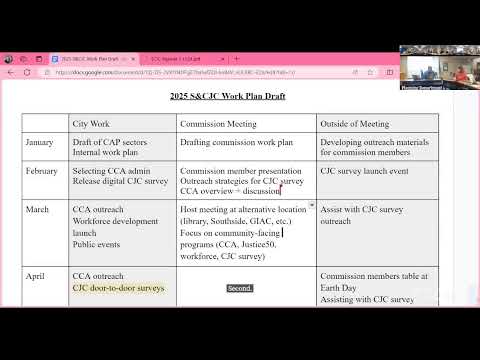
On program delivery and policy milestones, staff said the city’s Community Choice Aggregation (CCA) effort received approval on Christmas Eve and that the city expects to bring a contract for a CCA administrator to council. Staff said the Climate Action Plan (CAP) work is on a timeline that will require sustained commission review; staff listed drafting milestones through midyear and said a final draft is expected in July on the staff timeline. Staff also told commissioners they must submit the Climate Action Plan to the New York State Department of Environmental Conservation (DEC) as part of grant requirements.
Commissioners and staff agreed to prioritize public engagement. The commission’s climate justice community survey group discussed a tiered outreach approach—digital survey waves, in‑person events to collect survey responses, and targeted door‑to‑door follow up to collect responses in prioritized areas. Staff set a deadline for the survey: "It has to be done no later than, like, the last weekend in April," and the commission discussed holding a series of public events and tabling at existing community events to broaden reach. Commissioners recommended multiple review sessions for the CAP and deeper dives on complex items such as CCA, including two meetings focused on CCA and additional time to review CAP sections in depth.
A motion to approve the meeting minutes passed by voice vote during the session; the minutes motion was moved by Commissioner Justine and seconded by an attendee whose name was not specified on the record.
Commissioners discussed forming time‑bound subgroups to handle technical review and outreach tasks, and staff agreed to bring the CAP outline, sector chapter headings and related risk assessments to the commission to help structure monthly review. Staff also said federal and state grant deadlines and staffing availability will require flexibility in scheduling and recommended commissioners allocate more time than expected to review the CAP given its expected length and complexity.
No formal ordinance, resolution or binding council action was taken at this meeting; staff said the CAP will ultimately be presented to and adopted by City Council and that at least one public hearing is required before council adoption, which staff suggested would occur in October with adoption no later than the November council meeting.