Get Full Government Meeting Transcripts, Videos, & Alerts Forever!
Get email alerts on the Transportation Microtransit topic
No spam. Unsubscribe anytime.
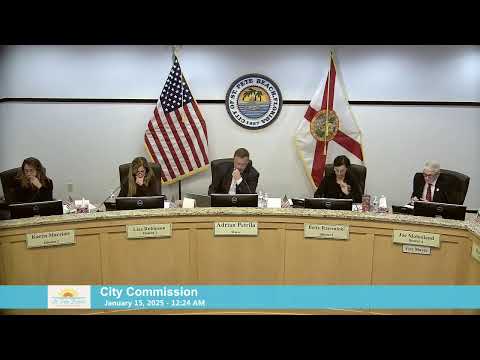
Microtransit debate stalls: St. Pete Beach rejects proposed fare and resident-priority plan, 3-2
Summary
After a presentation of ridership and cost figures, the commission rejected a motion to institute a $3 per-ride fare with resident exemptions and a $50 annual pass pilot for Freebee microtransit. The vote failed 3-2; commissioners and residents debated advertising revenue, terminal needs and equity for workers.
Freebee, the city’s contracted microtransit provider, presented ridership and cost data to the commission on Jan. 14, 2025, and answered questions about vehicle staging, charging infrastructure and advertising revenue. Following the presentation a motion to implement a pilot fare and resident-priority system failed on a 3-2 vote.
What was proposed: Freebee CEO Jason Spiegel told the commission the service had carried roughly 117,000 riders in recent years and that the city’s cost per rider fell from $8.06 in 2020 to $4.58 in the most recent fiscal year. Spiegel said the service expanded from one vehicle in 2019 to four vehicles citywide and noted persistent operating costs for vehicles, insurance and technology regardless of season. He suggested three levers the city could use to reduce net cost: sell vehicle advertising, institute fares for non-resident riders, or limit peak-season fleet expansion.
Council motion and vote: Commissioner (motion) proposed a fare pilot that would have charged $3 per ride for non-residents, exempted registered residents, and allowed a $50 annual flat pass for frequent users; the motion also allowed Freebee to solicit vehicle advertising. That motion failed on a 3-2 roll call (yes: Commissioner Robinson, Mayor Petrella; no: Commissioners Marriott, Resznicki, Vice Mayor Mahaland). The commission had earlier given Freebee direction to continue discussions and to present additional data if requested.
Key concerns raised: Commissioners and residents raised three recurring issues: - Terminal and staging capacity: Several commissioners and private drivers said the city lacks a dedicated terminal with charging and driver facilities large enough to support more than five vehicles; Freebee said it had planned a base at city hall and would install chargers but noted supply-chain delays had previously prevented in-season fleet expansion. - Equity and ridership composition: Commissioners asked how many riders are residents, workers or visitors; Freebee said the split varies by season (roughly 60/40 visitors/residents in high season) and offered a short-term resident-registration option that would require verification and a monthly transfer of the registration list to Freebee. - Reliability and wait times: Some residents and commissioners reported experiences of long waits or dropped requests. Freebee said recent software improvements provide an ETA and show stops ahead; drivers and some neighborhood users described peak-night congestion that can temporarily increase wait times.
Possible cost offsets discussed: Spiegel said advertising revenue could be shared with the city and suggested conservative estimates of $30,000–$75,000 annually depending on market demand. The company also said fares could be implemented and that combinations of resident exemptions and visitor charges could be programmed into Freebee’s system in 30–60 days if the commission directed that change.
Next steps: Commissioners asked staff to gather additional data on registered-user counts and terminal/charging options. Several commissioners urged the company and staff to return within 60 days with a recommended pilot that protects resident access while reducing net cost to the city.
Ending: The discussion underscored the competing priorities — reducing a municipal subsidy for mobility while preserving transportation access for residents and workers — and left the city without a new fare policy pending follow-up analysis and a potential pilot in the spring.