Get Full Government Meeting Transcripts, Videos, & Alerts Forever!
Get email alerts on the State Budget Overview topic
No spam. Unsubscribe anytime.
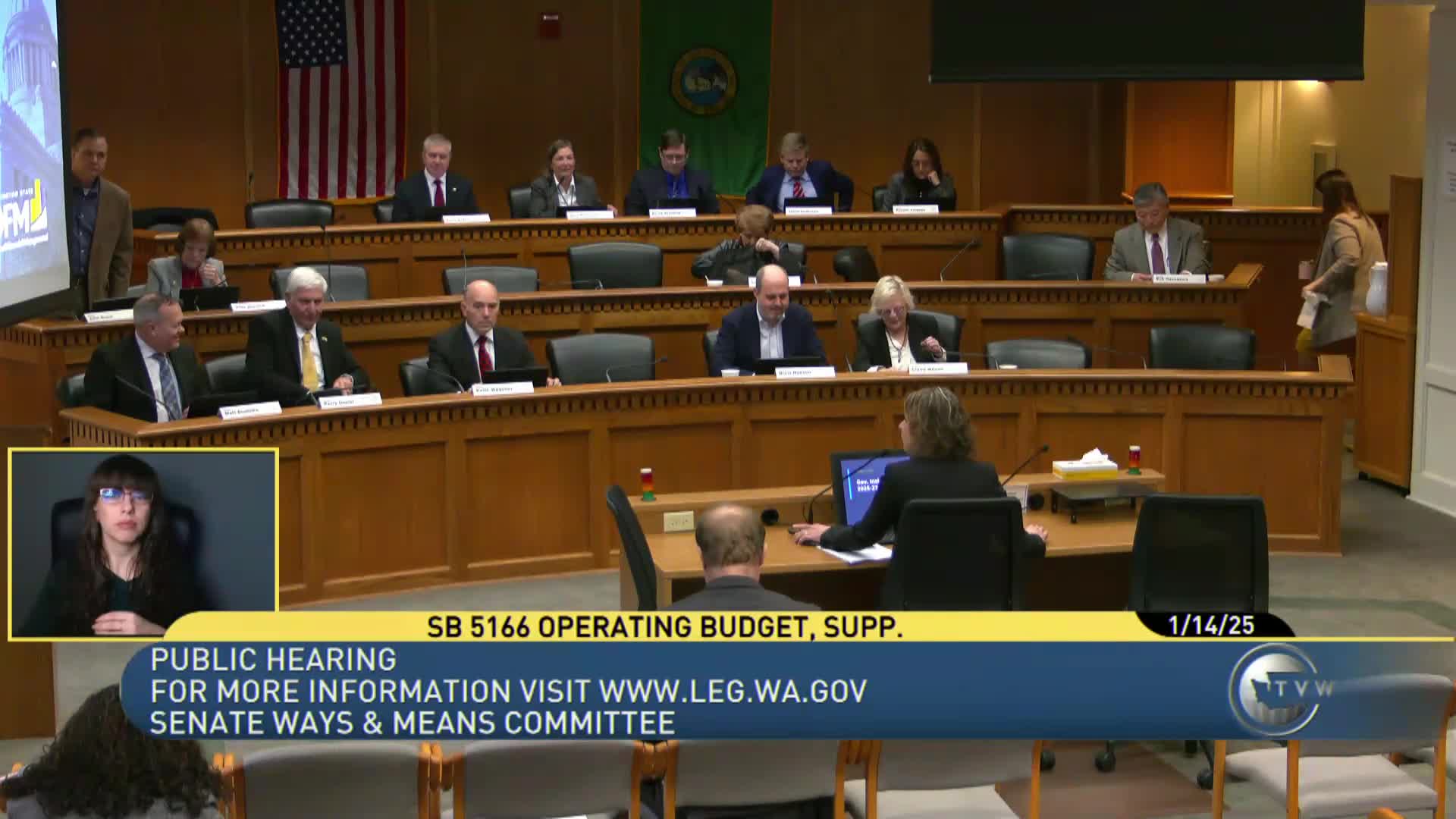
Ways & Means hears OFM briefing on Governor Inslee’s proposed 2025 operating budget
Summary
Nona Snell, director of the Office of Financial Management, briefed the Senate Ways & Means Committee on Governor Jay Inslee’s proposed 2025–27 operating and 2025 supplemental budgets, outlining revenue proposals, one‑time transfers and major appropriations and answering senators’ procedural questions.
Nona Snell, budget director at the Office of Financial Management, told the Senate Ways & Means Committee on Jan. 14 that Governor Jay Inslee’s proposed 2025‑27 operating budget responds to slowing revenue growth, rising caseloads and higher costs for state services.
Snell said the proposal preserves existing services where possible, ends programs deemed no longer needed, delays some program starts and uses one‑time transfers. She summarized several large moves that shape the revenue and appropriation outlook: a transfer earlier this decade of $1.6 billion from the Budget Stabilization Account into the general fund and an offsetting return in later years; combining portions of the Plan 1 and Plan 2 law enforcement and firefighter pension plans and transferring $1.0 billion of a plan surplus into the general fund; and a package of tax changes that the proposal estimates will raise substantial revenue in later years.
On tax changes, Snell said the governor proposes a 1% wealth tax on worldwide wealth above $100 million beginning in fiscal 2027 (the budget document cites a $10.3 billion revenue estimate), a temporary 20% increase in business‑and‑occupation taxes on services for businesses with receipts over $1 million that would start in October 2025 and end in 2026, and a permanent 10% adjustment to the B&O tax structure starting in 2027. She also described smaller revenue adjustments, including a change to unclaimed property estimated to raise $11 million and an adjustment to the tribal sales‑and‑use tax compact that reduces general‑fund revenue by about $39 million.
Snell outlined appropriations across the budget: maintenance‑level increases, a roughly $5 billion increase in 2025‑27 outlook appropriations and other policy‑level additions. She highlighted targeted investments in opioid treatment and prevention (for emergency departments and juvenile rehabilitation medical staff), behavioral‑health community settings, and the fourth phase of the Trueblood settlement agreement. The governor’s capital budget and operating proposal also delay parts of the Maple Lane expansion and reduce the Olympic Heritage Behavioral Health Facility appropriation to reflect projected expenditures, she said.
On housing, Snell said document‑recording fee collections have fallen short of prior projections; the governor proposes nearly $260 million in general‑fund backfill to sustain programs paid from that fee, including foreclosure‑prevention and local permitting grants. In early learning, Snell described an 18% rate increase for ECAP providers, a reconfiguration that converts 250 part‑day ECAP slots into full‑day slots and adds 500 additional full‑day school‑day slots, and a delay of the ECAP entitlement expansion to a later date.
Senators asked Snell for additional detail. Senator Braun asked about the Office of Financial Management’s certification that collective‑bargaining agreements are financially feasible; Snell answered that OFM’s determination considered workforce needs for delivering services and offered to provide supporting data if available. Senator Waggoner asked for a list and criteria showing programs that the governor identified as “no longer needed”; Snell said she would provide a long list of reductions and that the criteria included program usage and whether the program met need. When Senator Freme pointed out an apparent transcription error about which DOC facility would receive transferred youth, Snell acknowledged the correction and said she had misspoken.
The briefing closed and the committee opened a public hearing on the governor’s budgets.
Ending: The OFM presentation sketched the governor’s revenue and spending framework and prompted follow‑up questions about data behind feasibility certifications, program reduction lists and particular facility transfers. Committee members and public speakers spent the remainder of the session testifying about sector‑specific effects of the budget proposal.