Get Full Government Meeting Transcripts, Videos, & Alerts Forever!
Get email alerts on the I405 Sr167 Corridor topic
No spam. Unsubscribe anytime.
Cities and counties press Senate to fill $94 million gap for I‑405/SR‑167 corridor projects and add $2.5 million for SR‑167 implementation plan
Summary
Local elected officials and public‑works directors told the Senate Transportation Committee that escalating costs left a roughly $94 million shortfall on four critical I‑405 and SR‑167 projects now under construction, and several speakers asked lawmakers to add $2.5 million to the 2025–27 budget for a SR‑167 implementation plan
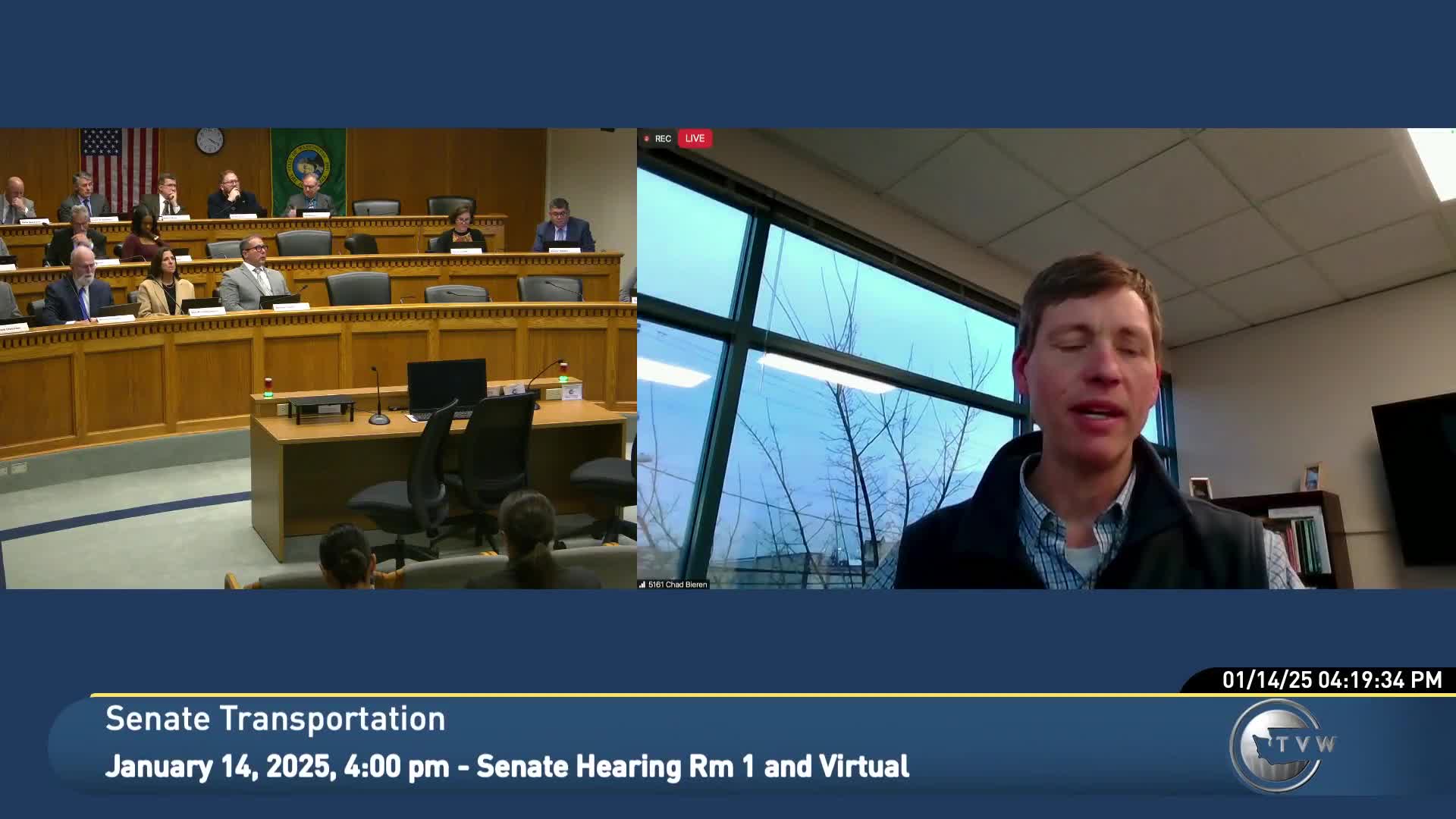
Several elected officials and local public-works leaders testified Jan. 14 during the Senate Transportation Committee’s public hearing on SB 5161, urging full funding of four critical projects on the I‑405 and SR‑167 corridor and requesting a $2,500,000 planning allocation for an SR‑167 implementation plan.
Chad Bearden, public works director for the city of Kent, told the committee that WSDOT recently completed an updated SR‑167 master plan integrating I‑405 and SR‑167 into a single corridor and that local officials need $2.5 million in the 2025–27 biennium to develop a detailed implementation plan. Bearden said the funding would prioritize multimodal options, promote transit and active transportation, improve safety, and support WSDOT’s Target Zero initiative.
Bellevue Councilmember Jared Newhouse and Bothell Councilmember Carsten Kurd urged the legislature to fill a roughly $94,000,000 gap on three projects currently under construction along I‑405 and corridor improvements on SR‑167, which they said is critical for regional access to Sound Transit’s planned bus rapid transit on I‑405. Newhouse said on-time delivery of the projects is essential to encourage transit ridership as employers and events (including the 2026 World Cup) increase travel demand.
Testimony from local officials emphasized that the corridor is a major freight and commuter route and that delays or underfunding could create imbalanced investments and missed opportunities for safety and transit integration. Several witnesses urged the committee to consider a new statewide transportation revenue package to address systemic needs, while urging the immediate step of closing the identified construction shortfall and funding the SR‑167 implementation planning work.
No formal action was taken during the hearing; testimony was entered into the record for the committee’s consideration.