Get Full Government Meeting Transcripts, Videos, & Alerts Forever!
Get email alerts on the State Budget topic
No spam. Unsubscribe anytime.
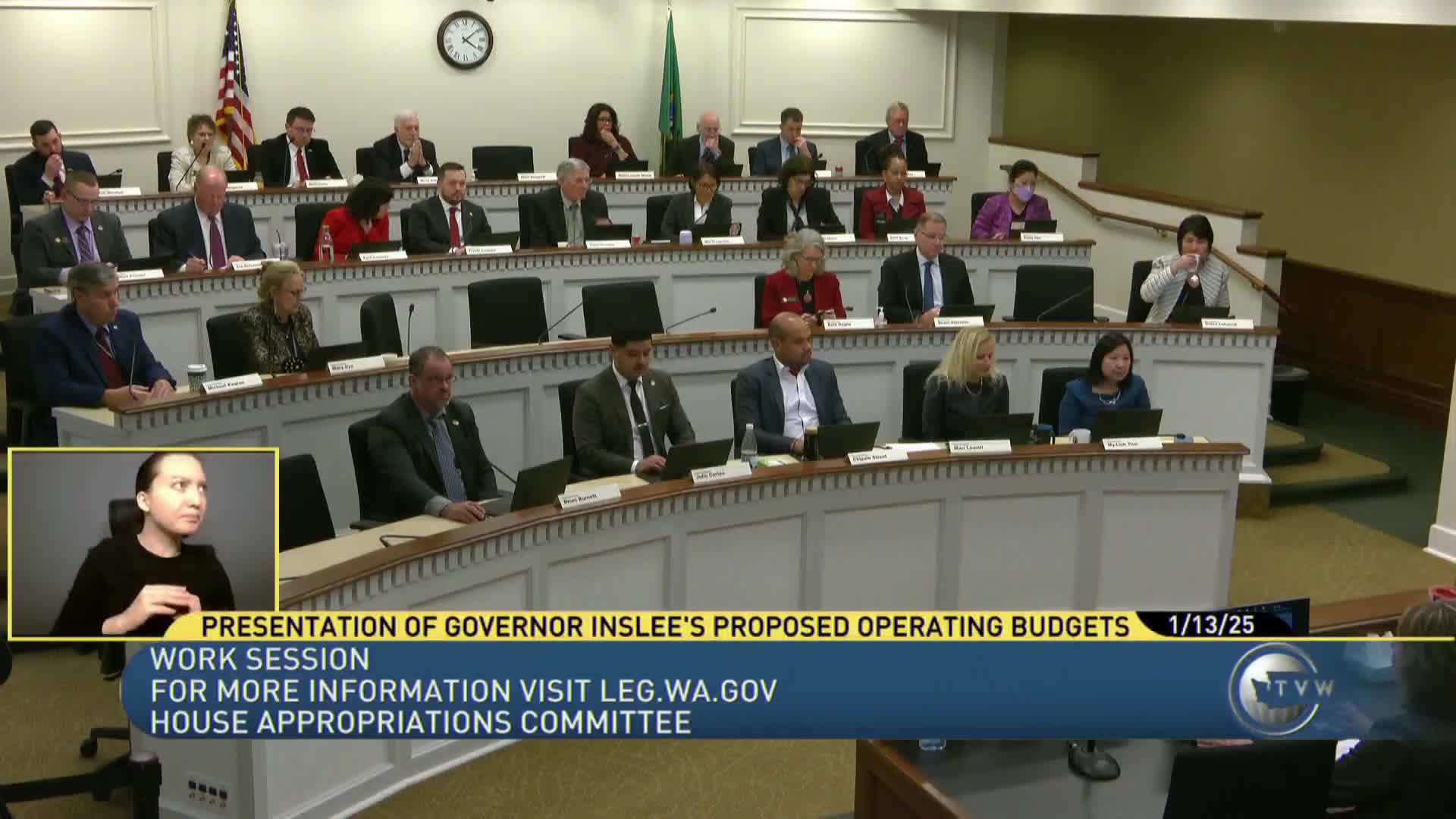
Appropriations Committee hears Inslee 2025–27 budget overview, revenue proposals and program changes
Summary
Budget director Nona Snell told the House Appropriations Committee that Governor Jay Inslee's proposed 2025–27 operating budget relies on new revenue measures including a wealth tax and changes to the business-and-occupation tax, and preserves many existing services while delaying or reducing some program expansions.
Budget director Nona Snell presented an overview of Governor Jay Inslee’s proposed 2025–27 biennial operating and the 2025 second supplemental budget to the Washington House Appropriations Committee, outlining a mix of new revenues, transfers from the budget stabilization account and a set of program maintenance, additions and reductions. "As you all are very aware, there are many challenges to this upcoming budget," Snell said, citing slowing revenue growth, rising caseloads, higher costs and workforce shortages.
The governor’s proposal would move roughly $1.6 billion from the budget stabilization account into the general fund in fiscal year 2026 with a transfer back in later years. Snell described a pension transaction that would combine Law Enforcement Officers’ and Firefighters’ (LEOFF) Plan 1 and Plan 2 pensions and transfer about $1.0 billion to the general fund in fiscal year 2026.
On revenue, the proposal includes a new wealth tax — a 1% levy on worldwide wealth above $100 million beginning in fiscal 2027 — that Snell said would raise an estimated $10.3 billion over the outlook period. The budget also proposes temporary and permanent increases to the business-and-occupation (B&O) tax (a temporary 20% increase on business services for firms with more than $1 million in receipts for late 2025–2026, and a permanent 10% increase on all B&O rates), a change to unclaimed property receipts and an increase in the tribal sales-and-use tax share for participating tribes from 60% to 100% (a decrease to state revenue estimated at $39 million). Snell summarized the net new revenue in the governor’s proposal as roughly $12.9 billion over the outlook period.
Snell highlighted priority areas and tradeoffs. In behavioral health, the proposal funds community settings for people moving out of inpatient care, implements Phase 4 of the Trueblood settlement, and funds 75 long-term civil commitment beds at the University of Washington Behavioral Health Hospital; it also delays opening some units at Maple Lane and reduces funding tied to projected operating costs at Olympic Heritage Behavioral Health. In housing, the budget backfills a shortfall in the document recording fee with $258 million of general fund to continue consolidated homeless grants and other housing services. Early learning and child care measures include an 18% increase to ECAP provider rates, 750 additional ECAP school‑day slots and maintaining Working Connections child care provider rates at the 85th percentile as required by law, while delaying an ECAP entitlement that had been scheduled for the 2026–27 school year.
Snell also noted reductions and schedule changes across human services, higher education and climate programs. The capital and operating proposals include continued work on behavioral health facility readiness, $950 million in Climate Commitment Act appropriations across budgets, and creation of a Clean Energy Development Office and a transmission authority to accelerate clean energy and transmission development. She closed by inviting questions; none were offered during the session before the committee moved to public testimony on the biennial and supplemental bills.
The presentation and the public hearing that followed made clear the budget package relies on a mix of near‑term revenue changes and program timing adjustments to preserve services while finding savings.
Ending: The committee transitioned from Snell's presentation directly into a public hearing for House Bill 1198 (the 2025–27 biennial operating bill) and House Bill 1197 (the 2025 second supplemental).