Get Full Government Meeting Transcripts, Videos, & Alerts Forever!
Mercer Island School District projects $3 million shortfall, urges state funding and local action
Summary
Superintendent (name not specified) warned Mercer Island School District residents that the district projects roughly a $3 million shortfall for the 2025–26 school year and said the district has “run out of tricks” to cover rising costs without new revenue.
Superintendent (name not specified) warned Mercer Island School District residents that the district projects roughly a $3 million shortfall for the 2025–26 school year and said the district has “run out of tricks” to cover rising costs without new revenue.
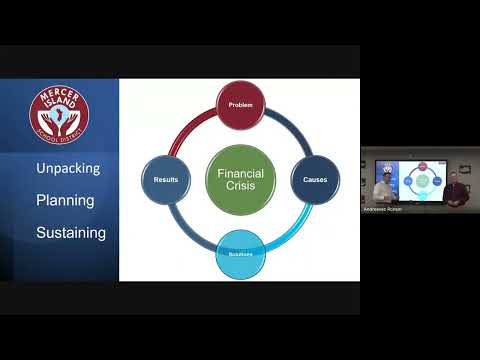
The district’s short-term finances remain solvent for this school year, Superintendent (name not specified) told the live webinar audience, but he said “if we receive no new revenue at all ... as we head into 25, 26 … we project it will be about $3,000,000 short.” The district said enrollment—3,900 students so far this school year—remains the primary driver of state funding because state payments follow student full‑time‑equivalent (FTE) counts.
The message: why it matters
The shortfall stems from a mix of structural and local factors that district leaders said the state must address: limits on local levy collections, underfunding of special education, steep increases in insurance and operating costs, and growing transportation expenses. The superintendent framed the shortfall as partly the result of changes since the McCleary litigation and a state cap on local Educational Programs and Operations (EP&O) levies that the district says is limiting local revenue.
What the district told families and supporters
At the start of the presentation the superintendent summarized the district’s approach: use conservative enrollment projections, limit discretionary spending, and avoid deficit spending. Matt Sullivan, executive director, explained funding mechanics: “FTE stands for full time equivalent ... we’re funded via the state of Washington, OSPI, the Office of the Superintendent of Public Instruction via our student FTE.”
Leve…
Already have an account? Log in
Subscribe to keep reading
Unlock the rest of this article — and every article on Citizen Portal.
- Unlimited articles
- AI-powered breakdowns of topics, speakers, decisions, and budgets
- Instant alerts when your location has a new meeting
- Follow topics and more locations
- 1,000 AI Insights / month, plus AI Chat