Get Full Government Meeting Transcripts, Videos, & Alerts Forever!
Get email alerts on the Child Welfare Permanency topic
No spam. Unsubscribe anytime.
Court keeps reunification and APLA as dual goals for two teens; sets 90‑day review for April 14
Summary
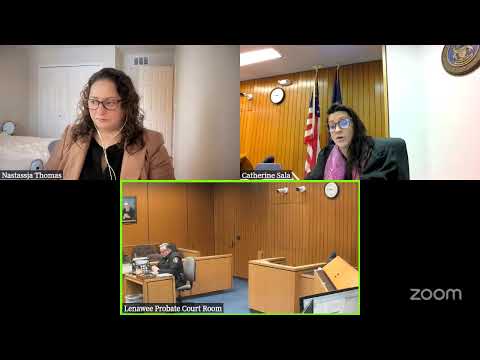
The Lenawee County Probate & Juvenile Court continued reunification as the primary permanency goal and retained APLA as a concurrent goal for two teenage brothers, and set a 90‑day review for April 14 at 10 a.m., the court said during a permanency planning hearing.
The Lenawee County Probate & Juvenile Court continued reunification as the primary permanency goal and retained APLA as a concurrent goal for two teenage brothers, and set a 90‑day review for April 14 at 10 a.m., the court said during a permanency planning hearing.
The court also admitted the Department of Health and Human Services'court report with attachments into evidence and ordered the children to remain in their current foster placement in Macomb County pending the next review.
The decision leaves the children, ages 16 and 15, in place where attorneys and department staff said they are doing better in school and are ‘‘getting along with their foster siblings and feeling more comfortable in that placement.’’ Galen Young, Department of Health and Human Services, told the court that both boys reported they would like to remain in their current foster home until their parents secure more stable housing.
Why it matters: The court identified housing stability and verified income as continuing barriers to reunification, and the department asked the court to continue a 90‑day review cycle so it can monitor progress in parenting, housing and services received by the children.
Decisions and orders
- The court admitted the department's court report with attachments without objection. Nastasia Thomas, counsel for the department, moved to admit the report; no party objected. - The court kept reunification as the primary goal and APLA as a concurrent/secondary permanency goal for the two children. - The court ordered the children to remain in their current foster placement in Macomb County pending the next review. - The next permanency review was scheduled for April 14 at 10:00 a.m.; the judge said a written order would be prepared.
What was discussed
Department and caseworker updates: Galen Young of the Department of Health and Human Services summarized the department's report and attachments and described progress during the reporting period. Young said both children reported improved adjustment in their placement and better school performance, and that supervised visits with their parents were continuing through a parenting/visitation program.
Services and program details: The court record shows the family has been participating in the Orchards family visitation and parenting support program (referred to in the hearing as the Orchards Visitation Support Program). The program combines supervised visitation with one‑on‑one parenting education; department staff said about 12 weeks of the program remained for the parents at the time of the hearing.
Behavioral health and schooling: The department noted school‑based concerns for attention and focus for the younger child (identified in the record by initials). The child has an IEP that department staff said does not currently address the attention concerns; the department said it would seek a reassessment through CMH for possible ADHD and consider therapy or, only with proper consent, medication if clinically indicated. Galen Young said the department had discussed the possibility of medication with the parents and acknowledged the parents'preference against medicating the child.
Housing, income and transportation: Department staff reported the parents had been staying with a friend and that the placement was reported to have provided stability for the children. The department said it needs verification of the parents'income and that housing verification remains outstanding; the judge directed staff to verify these items in the next reporting period. Department staff also said the agency provides gas cards for transportation to help address distance issues related to the placement in Macomb County.
Parents and testimony: The parents declined to testify during the hearing. Attorneys and the department discussed the parents'participation in supervised visits and parenting education; the department characterized parental compliance as partial and described continuing work on parenting skills and budgeting supports.
Comments from counsel and others: Michael Brooks, a court participant who questioned witnesses and commented in the hearing, characterized the family's primary barrier as lack of financial resources, saying, "They're poor. And I don't know what the heck we are supposed to do with that other than what has happened." Court counsel and the judge emphasized the children's progress in placement and school as a reason to maintain stability while the parents continue services.
Context and history
The judge noted this is a long‑running case (referred to in the hearing as a ‘‘2009 case’’) and that parenting and housing problems are longstanding barriers to reunification. At a prior hearing the court had changed the goal to a dual goal including APLA; the court said that remains appropriate because of the boys'ages and the need to develop independent living skills.
What happens next
The court directed the department to verify the parents'housing and income for the next report and kept the case on a 90‑day review cycle; the next permanency planning review was scheduled for April 14 at 10:00 a.m. The judge said an order would be prepared and issued following the hearing.
Ending
With the court keeping reunification as the primary goal while retaining APLA as a concurrent plan, caseworkers and counsel will report back at the April review on housing verification, income documentation, progress in the Orchards visitation/parenting program and any updated recommendations from CMH following reassessment for attention concerns.