Get Full Government Meeting Transcripts, Videos, & Alerts Forever!
Get email alerts on the Public Works topic
No spam. Unsubscribe anytime.
Residents press Cocoa for cleaner corridors and water access; council and staff promise follow-up
Summary
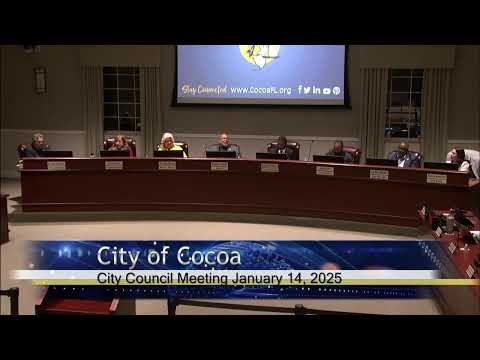
Residents told the Cocoa City Council on Jan. 14 that large stretches of State Road 524 and nearby corridors are littered with trash and that city contractors appear not to be removing debris; a separate commenter described a long-running lack of potable water and asked about temporary hydrant-meter solutions.
Residents used the Jan. 14 public‑comment period to press the City of Cocoa on two infrastructure issues: roadside litter and neighborhood cleanup along state Route 524 and ongoing water-access problems in outlying neighborhoods.
Willie Wade, a long‑time Cocoa resident who said he lives off 524, told the council that when drivers leave I‑95 and enter eastbound on 524 “there’s nothing but a lot of trash, a lot of litter, and it’s not a good look for the city.” Wade reported he had been told by the Florida Department of Transportation that the corridor from Cox Road to Industry Road is supposed to be maintained by the City of Cocoa Public Works, and he said the city’s contractor, US Lawns, had told him the contract requires mowing but not trash pickup.
Council members said they have received similar complaints and asked staff to investigate. Councilman Goins and others said the city needs to press the contracted landscaping firm to fulfill its obligations or consider finding a more responsible contractor. City staff said they would follow up with Public Works and the contractor; staff also noted Waste Management and the city are discussing options for more regular yard/bulk pickup (a subscription-style regular yard-waste pickup was described in staff remarks and is being priced), and that code enforcement has recently hired two new officers to increase proactive enforcement.
Another commenter, identified in the meeting as Ted Ford, described long-running problems obtaining potable water at the end of his road. Ford said temporary measures such as placing a meter on a hydrant and billing for usage are used on construction projects elsewhere and asked whether a temporary hydrant-meter hookup could serve residents while longer-term solutions are researched. The city manager said the water access issue is under research and that staff were exploring temporary options; a city official present described hydrant meters as an industry practice used at construction sites but said water-quality concerns (Ford reported a driller’s warning about arsenic) and utility rules can affect feasibility.
Council members suggested short‑term and medium‑term steps: (1) get clear written statements of contractor scope from Public Works and, if necessary, require corrective action or replace the contractor; (2) coordinate with Waste Management about more frequent or scheduled yard/bulk pickups for problem corridors, subject to pricing; (3) use code enforcement to log and follow up repeat locations and to issue notices when cleanup is the property owner’s responsibility; and (4) staff to explore hydrant‑meter temporary hookups where safe and allowed by the utility, with clear billing and quality‑control rules.
Ending — follow up: Staff said they would meet with US Lawns and Waste Management, price regular yard-waste pickup options, and return with recommendations; code enforcement will prioritize repeat problem locations. For the water-access issue, residents and staff were told staff will continue research and attempt to identify a short‑term temporary metered hydrant solution if feasible and safe.