Get Full Government Meeting Transcripts, Videos, & Alerts Forever!
Get email alerts on the Public Safety topic
No spam. Unsubscribe anytime.
Commission approves contract with Flock for license‑plate reading system after privacy questions
Summary
After a presentation from Sarasota Police Department staff and public questions about privacy, the commission approved a professional services contract for the department's Flock license‑plate reader (LPR) operating system, voting unanimously to move forward.
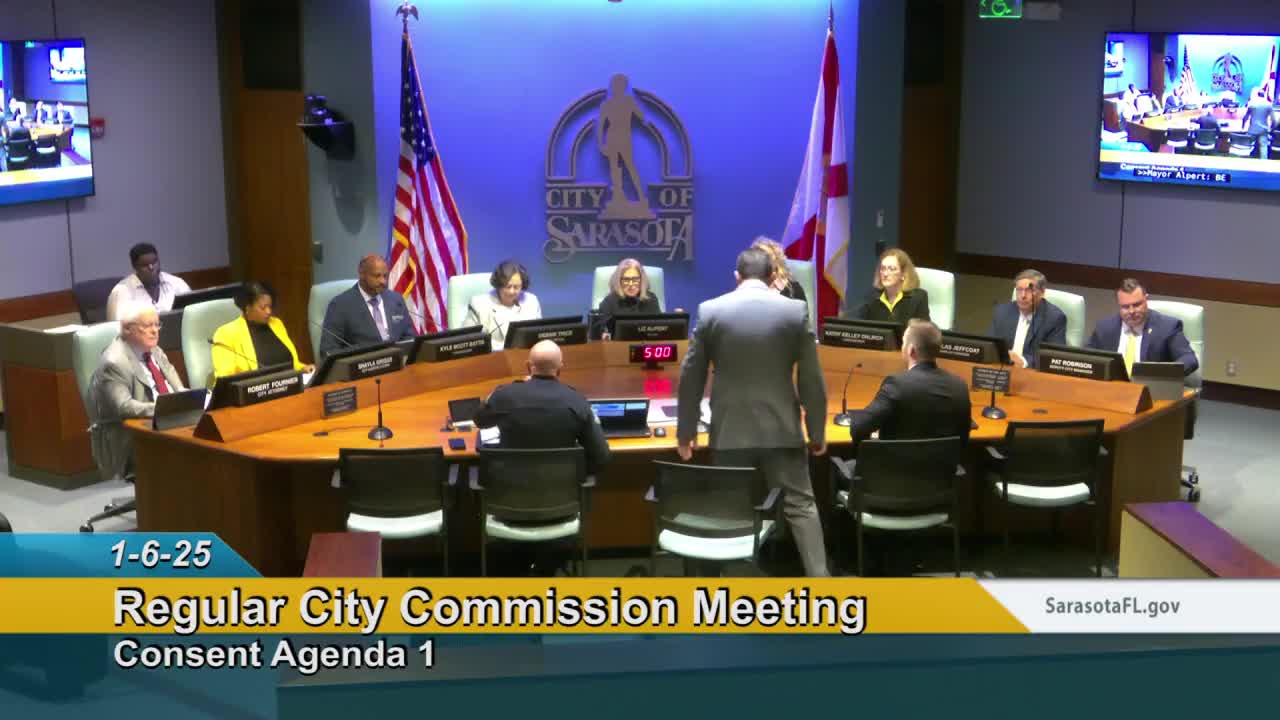
Sarasota Police Department staff told the City Commission on Jan. 6 that the department has used license‑plate reader (LPR) technology for years and that the contract before the commission was for the operating software, not the purchase of new camera hardware. Commissioners voted unanimously to approve the professional services contract with Flock Group.
"Today, what we're seeking, is not the authorization to purchase new cameras. This, in front of you today is really an operating system contract with, Flock," said Captain Dimitri Constantopoulos, support services division. John Lake, manager of the Real Time Operations Center, emphasized the system is an investigative tool: "I think there's a little bit of misconception about license plate readers. They're only used when you commit a crime... We're not tracking anybody." (John Lake)
The police presenters said the department has deployed stationary LPRs in public spaces (35 stationary readers in the last three years) and also uses Axon LPRs integrated with body‑worn cameras. The department described its governing procedures: use is controlled by department standard operating procedures (SOP 414), training is required, and the system produces an electronic audit trail of access. Staff said FDLE/CJIS rules apply to interagency sharing and MOUs when detectives work with other agencies.
On retention, staff said FDLE allows data retention for criminal investigations up to three years; the city currently maintains LPR data for one year and staff reported no known data breaches. Staff also noted the system is used regionally: "We do coordinate with Sarasota County, Longboat Key, City of Bradenton, Manatee County, North Port, Venice because criminals don't know boundaries and this really breaks those boundaries down for our investigative efforts," a department witness said.
Commissioners asked whether the LPRs were related to a separate school‑zone camera program; staff confirmed they are separate systems. After public comment and questions from commissioners, Vice Mayor Trice moved to approve the contract and Commissioner Bati seconded; the motion passed unanimously.
Why it matters: commissioners and members of the public raised civil‑liberties and privacy concerns before staff presented clarifying details about the system's scope, safeguards and retention. SPD emphasized the tool is investigative (used in connection with crimes) and is governed by state guidelines and the department's SOP.
Next steps: staff will finalize the operating system contract with Flock and continue to apply SOP 414 and FDLE/CJIS guidelines to access and interagency sharing. The commission recorded the vote as unanimous.