Get Full Government Meeting Transcripts, Videos, & Alerts Forever!
Get email alerts on the Homelessness topic
No spam. Unsubscribe anytime.
Matthews Hope seeks council backing to park ‘dignity buses’ as overnight shelters amid state deadline
Summary
Matthews Hope asked Cocoa City Council for a formal “vote of confidence” to allow the nonprofit to park mobile sleeper buses on its private lot while it operates a countywide sheltering program funded with time-limited state dollars. Council members asked for the contract and zoning guidance; no formal approval was taken at the meeting.
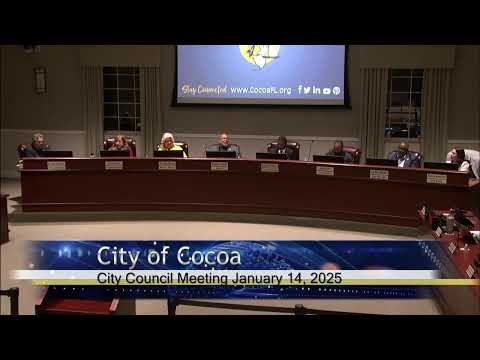
Matthews Hope asked the Cocoa City Council on Jan. 14 for a formal “vote of confidence” to allow the ministry to park three mobile “dignity buses” on Matthews Hope’s private lot and run them as nighttime sleeping spaces while a countywide contract is finalized.
The request came from Scott Belew of Matthews Hope, who told the council the state has made $10 million available for sheltering but that the money must be spent by June 30. Belew said Matthews Hope already has $300,000 pledged by a donor and that each bus would provide roughly 20 sleeping spaces — a total of about 60 beds — that would operate as “sleepers” only and return guests to their pickup locations each morning.
The issue matters, supporters said, because a recent Florida law identified by speakers as House Bill 1365 and described in the meeting as effective Oct. 1, 2024, is increasing pressure on local providers and has created an urgent funding timetable for sheltering.
Belew described the buses and the proposed arrangement: “These buses would operate throughout Brevard and would park in designated areas in the various municipalities willing to partner with us.” Shannon Diaz, identified in the meeting as Matthews Hope’s Orange County director and a formerly homeless person who graduated the ministry’s program, said, “These buses could change 60 people’s lives.”
Council members and staff focused on legal, zoning and community-notification issues. City Attorney Joseph Garganese (City Attorney) explained that whether a vehicle may be parked on private property for that use depends in part on the property’s zoning and on whether the proposed activity constitutes a “shelter” or another use that triggers separate regulatory requirements. He noted routine parking questions are governed by the city’s zoning code.
Council members asked whether the contract between Matthews Hope and the Brevard Homeless Coalition existed; Belew said the coalition hoped to sign a contract with Matthews Hope by the end of January so that state funds could be spent by June 30. Deputy Mayor Patricia Weeks and others urged Matthews Hope to share the contract and to meet with downtown merchants before the council took a position. Council members also asked staff to review whether parking buses at a church or nonresidential site would require a council endorsement or simply compliance with zoning code.
Brevard Homeless Coalition was identified in the meeting as the county lead that received the state funding and solicited service providers; Amber Carroll (identified in the meeting as Brevard Homeless Coalition director) had contacted Matthews Hope about providing the sleeper buses to spend the funds. City staff and the city attorney repeatedly framed the matter as a mix of county-level coordination (the coalition and the fund) and routine zoning/parking regulations that the city enforces.
No formal vote by the council occurred on the Matthews Hope proposal at the meeting. Council members asked for (1) the contract offered by Matthews Hope and/or the Brevard Homeless Coalition, (2) zoning-code guidance about parking buses on private property and whether any endorsement or waiver would be required, and (3) outreach to downtown merchants so merchants and residents could be briefed before any council action.
The matter remains under review by staff and legal counsel; Matthews Hope representatives said they would share the contract and that the organization preferred to proceed in “good faith” with city partners rather than unilaterally parking vehicles without city input.
For now, the council recorded no formal approval or denial; council members said they wanted the contract and legal/zoning analysis in hand before deciding whether to take official action.
Ending — next steps: Matthews Hope representatives were asked to provide the proposed contract and additional operational details to city staff. City legal and planning staff will review zoning questions (whether the site is commercial, institutional or residential and which parking rules apply) and return with guidance to the council at a future meeting.