Get Full Government Meeting Transcripts, Videos, & Alerts Forever!
Get email alerts on the Ems topic
No spam. Unsubscribe anytime.
Lewis County EMS reports progress on ALS rollout, FEMA grant for ambulance
Summary
Lewis County Emergency Medical Services reported plans to begin ALS operations soon, submission of a FEMA grant for a new ambulance, recent equipment acquisitions, and staffing updates; the Fiscal Court heard the report and asked follow‑up questions about timing and staffing.
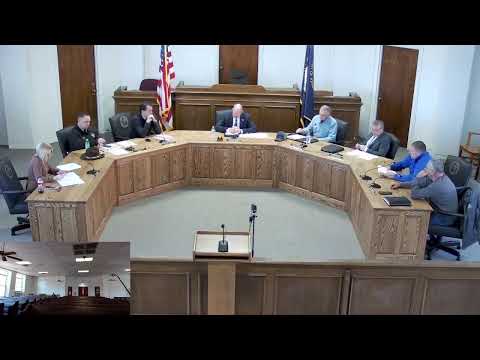
Lewis County Emergency Medical Services director Michael Bibles told the Fiscal Court on Jan. 13 that EMS is preparing to begin Advanced Life Support (ALS) operations, has applied for a FEMA grant to purchase a new ambulance, and is adding equipment and staff in anticipation.
Bibles reported that EMS ran 126 calls for the most recent reporting period and transported 94 patients. He said the service recorded 27 refusals, two cardiac arrests, one dead on arrival and two incidents with no patient contact. Bibles reported an average on‑scene time of about 1 minute 55 seconds and an average county response time of 14 minutes, with roughly 38% of responses under eight minutes. He described those response statistics as “really good for a county our size.”
Bibles said EMS submitted a FEMA grant for a “little over $200,000” to fund a new ambulance; he said a demo unit is waiting and could be placed into service if the grant is awarded. The service also completed a purchase from Maysville Fire Department for $20,000 that included a used ambulance, a power cot (spare) and a center rail to secure a cot inside a truck.
On staffing and ALS readiness, Bibles said the department currently has two paramedics on staff and expects to hire additional personnel. He said three paramedics were lined up to join when ALS is deployed and two EMTs were waiting to be hired full time. Bibles estimated deployment of two ALS crews “probably February to March,” pending arrival/servicing of equipment and completion of training. One monitor needed servicing, he said, and training cannot be completed until that equipment is ready.
The Fiscal Court thanked EMS and its mutual‑aid partners (road crews, sheriff’s deputies and volunteer fire departments) for assistance during recent severe weather and for help reaching patients on difficult roads.
Bibles also noted recent training—ALS protocol training and other provider education—and the acquisition of a spare power cot to ensure continuity of care if a primary cot becomes out of service. Court members asked for a ballpark timeline for ALS deployment; Bibles reiterated the February–March window but said a service date depends on equipment arrival and certification.
No formal action or funding vote was taken at the meeting on EMS matters; the board received the report and acknowledged planned grant applications and staffing steps.