Get Full Government Meeting Transcripts, Videos, & Alerts Forever!
Get email alerts on the Land Use Rezoning topic
No spam. Unsubscribe anytime.
Putnam County denies rezoning for 130 Smith Lane fish camp after neighbors and commissioners raise road, deed concerns
Summary
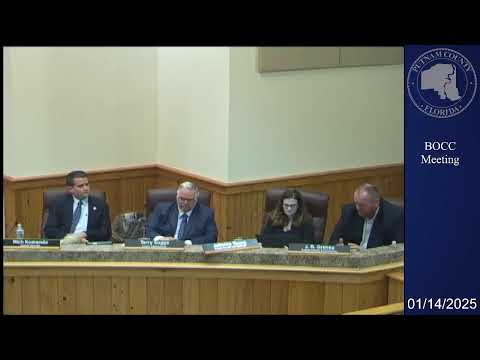
The Putnam County Board of County Commissioners voted 3–2 on Jan. 14 to deny a rezoning request that would have converted 130 Smith Lane in Crescent City into an RV‑style fish camp, citing access on a private unpaved road, outstanding deed issues and unconsenting neighbors.
The Putnam County Board of County Commissioners voted 3–2 on Jan. 14 to deny a rezoning request from Commercial Neighborhood (C‑1) to Planned Unit Development (PUD) for 130 Smith Lane in Crescent City, a 2.8‑acre property the applicant intends to reestablish as a fish camp with up to 15 pads, new owner residence and accessory structures.
Planning staff told the board the parcel does not meet the comprehensive plan standards for C‑1, and the site is accessed by a private, unpaved local road. Jennifer Gsella, Planning and Development Services staff, said the applicant voluntarily offered a roadway maintenance and improvement agreement to pave Smith Lane within five years if the PUD is approved, and that 15 of the roughly 20 landowners along Smith Lane had signed that agreement. Staff nonetheless recommended denial because the development would be accessed by an unpaved private road and did not meet acreage requirements for overnight recreational parks.
Neighbors and property owners urged denial or asked for stricter protections. One longtime resident, Andy Blueoff, said the shared boat ramp and easement had been blocked for years and cited a 1981 Putnam County court ruling that affirmed deeded access for residents. He argued the proposal would give the applicant control over a shared resource and called the parcel “landlocked” for a business that would depend on public access. Robert Maurer, the applicant, told the board he cleaned up the site and installed temporary fencing and a locked gate for security, and said his plans include maintaining the roadway and restoring the fish camp character.
Commissioners focused on private‑road ownership, potential impacts on non‑signing neighbors and the county’s legal exposure if it approved a use that relied on a road it does not own. County attorney Rich Kamin told the board it must weigh code criteria and the staff recommendation; approving a rezoning that contradicts the land‑development code could expose the county to liability. Commissioner Harvey repeatedly raised the difficulty of imposing county maintenance or conditions on a privately owned roadway for which some owners had not consented.
Following public comment and discussion, Commissioner Harvey moved to uphold the staff recommendation to deny the rezoning; the motion passed 3–2. The denial leaves the property’s current options unchanged: staff noted the owner could pursue uses allowed under the current future land use (a fish camp minus an owner residence) or rezone to residential and build a residence under R‑1 rules.
The vote does not change the civil‑court history around the easement that speakers referenced; residents said they intend to pursue enforcement of deeded access through the courts if necessary.
The board did not adopt any amendments or conditions to permit a different outcome today.
Ending: The denial leaves open non‑zoning paths for the owner and keeps potential road‑improvement obligations tied to private negotiations among property owners. The applicant and residents were told enforcement of deeded access and any future disputes are matters for the civil courts unless the owners reach a private agreement or resubmit a different application.