Get Full Government Meeting Transcripts, Videos, & Alerts Forever!
Get email alerts on the Ev Infrastructure topic
No spam. Unsubscribe anytime.
Committee approves substitute to expand EV charging readiness in new Atlanta construction
Summary
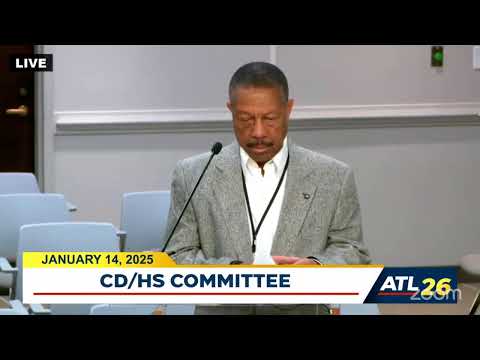
The Community Development and Human Services Committee voted 6-0 to approve a substitute ordinance (250-1011) that tightens electric vehicle (EV) charging readiness requirements for new commercial and residential construction, following technical presentations from city staff and supportive testimony from local EV advocates and businesses.
The Community Development and Human Services Committee voted 6-0 to approve a substitute to ordinance 250-1011, updating electric vehicle (EV) charging infrastructure readiness requirements for new commercial and residential construction in Atlanta.
The substitute, described in the ordinance title as amendments to Part 3, Appendix B, Chapter 1, sections 101.8 and 101.9, passed after a presentation by Shondra Farley, the city’s chief sustainability officer. Farley told the committee the update aligns the city with industry standards, helps leverage roughly $18,000,000 in federal funding the city has attracted for related work and supports planned installations such as charging at the government center parking deck. “This will be critical to bring us in line, not only with our peers, but industry standards,” Farley said.
Why it matters: supporters said stronger EV readiness in new construction reduces the need for costly retrofits, expands charging access for residents who cannot charge at home, and supports the city’s climate goals. Dozens of public commenters and industry representatives urged approval during the meeting’s public comment period. Dr. Shelly Francis, co-founder of EV Noir, said the amendments “prioritize equity, ensuring that historically underserved communities, particularly in Atlanta’s west, southwest, and south regions are not left behind.”
Public testimony and supporting data: multiple commenters cited research and industry estimates to make the case for incorporating EV infrastructure during construction. Justin Breitharp of the Southeast Energy Efficiency Alliance referenced U.S. Department of Energy guidance that most charging occurs at home or work and cited a Pacific Northwest National Laboratory estimate that much of retrofit cost can be avoided when charging infrastructure is added during construction. Anne Blair, vice president of policy at the Electrification Coalition, said a 2024 J.D. Power study shows concern about charging access has grown and endorsed the proposed ordinance amendments.
Committee discussion and vote: committee members praised the ordinance’s equity focus and potential to reduce “range anxiety” for drivers without reliable home charging. Chair Jason Winston and other members spoke in support before Councilmember Westmoreland moved approval as substituted; Councilmember Bakhtiar seconded. The vote was recorded as 6 yays, 0 nays and the item was reported favorable on substitute.
What the ordinance does (as discussed at the meeting): per staff remarks and public testimony, the substitute updates definitions and technical references, clarifies processes for implementation, and increases EV supply equipment (EVSE) readiness and installation requirements for new commercial and residential construction. City staff and advocates said the changes are intended to (1) lower future retrofit costs, (2) expand charging access in historically underserved neighborhoods, and (3) support fleet and community emissions reductions. Specific implementation details, timelines, and enforcement provisions were discussed at a high level but the substitute passed without additional amendments at the committee level.
Next steps: the ordinance was before the committee as a second-reading item and advanced out of committee after the favorable vote; subsequent readings and final adoption steps will occur at full Council per the city’s legislative process.
Ending note: committee members and city staff encouraged continued public engagement and technical collaboration with community groups and industry partners as implementation proceeds.