Get Full Government Meeting Transcripts, Videos, & Alerts Forever!
Get email alerts on the Parking topic
No spam. Unsubscribe anytime.
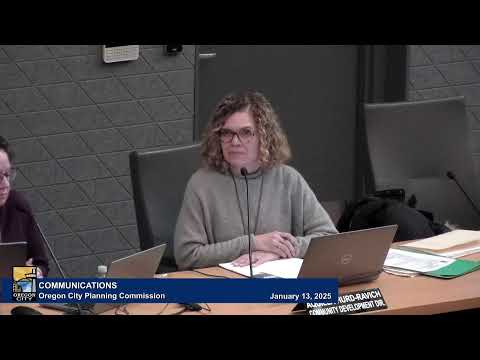
Oregon City planners weigh state-mandated parking reforms, EV and landscaping rules under CFEC
Summary
City of Oregon City planning staff and consultant Brian Davis presented an initial plan Jan. 13 to implement Oregon's Climate Friendly and Equitable Communities administrative rules, outlining three compliance paths that would alter parking minimums, require EV-ready infrastructure and impose landscaping, solar or fee-in-lieu options for new or reconfigured parking.
City of Oregon City planning staff and consultant Brian Davis presented an initial implementation plan on Jan. 13 for the state’s Climate Friendly and Equitable Communities (CFEC) administrative rules that would change local parking requirements, add EV infrastructure standards and require new landscaping or solar options for parking lots. The presentation and discussion were informational; the commission did not vote on code language and staff said formal legislative hearings are scheduled this spring.
The issue matters because the administrative rules — adopted at the state level by the Department of Land Conservation and Development (DLCD) and its Land Conservation and Development Commission (LCDC) — require cities in metropolitan areas to choose a compliance path that affects how developers provide parking, design lots and add electrical infrastructure. "One of the requirements there, if you took option 2, is the idea of unbundling parking," Davis told the commission, describing the second compliance option. "Property owners shall be allowed to redevelop any portion of existing off street parking areas for bicycle oriented and transit oriented facilities," he read from the administrative language, citing OAR provisions that guide the changes.
Davis told the commission there are three broad compliance options outlined in the new state rules: remove parking minimums citywide (the option most jurisdictions are taking), adopt a menu of significant parking reforms (including measures like unbundling parking from rents) or adopt a prescriptive set of interventions the consultant described as the "path of least resistance" for Oregon City. Staff and the ad hoc committee convened last year recommended option 3 — a targeted, prescriptive approach — because it keeps minimums in some outlying areas while avoiding implementation and monitoring burdens that would come with option 2.
Key elements staff identified: - Parking minimums: The CFEC administrative rules prohibit requiring parking minimums in climate-friendly areas and within a half-mile of frequent transit (identified locally as TriMet Line 33). In those areas the rules also require parking maximums, particularly for multifamily housing. - Redevelopment of underused off-street parking: OAR language cited by staff allows property owners to convert portions of existing off-street parking to uses such as bicycle parking, bus stops, parklets or food carts. Staff said the rules give property owners latitude to declare underuse, and the commission discussed whether requiring a parking study could be used to show underuse before conversion. - Landscaping, solar or fee-in-lieu: For new or reconfigured parking areas the rules require one of three options: new landscaping (including a tree canopy metric), solar panels sized to produce a set amount of power per parking space, or payment of a fee in lieu of at least $1,500 per parking space into a Clean Energy Fund. Members of the city’s ad hoc committee strongly urged removing the fee-in-lieu option; other commissioners said a high fee accompanied by transparent use rules could preserve flexibility. - EV charging: The rules require conduit or infrastructure so that a percentage of spaces (Davis described the standard for new multifamily as 40% of parking spaces for residential developments over five units, with conduit for Level 2 charging) can be electrification-ready. Staff said the requirement generally calls for conduit and electrical capacity rather than necessarily installing the charger equipment immediately. - Bike and small-scale mobility parking: The administrative rules call for bike parking at "key destinations" (defined by the state) and allow cities to define standards for larger cargo or family bikes. Staff noted some local stakeholders asked for provisions that accommodate larger e-bikes and cargo bikes. - Multifamily parking maximums: Within transit proximity areas the state sets lower multifamily parking maximums (Davis cited a reduction to roughly 1.2 spaces per studio unit and 2 spaces per other unit in those areas), while the city’s current citywide maximum is higher (about 2.5 spaces per unit). Commissioners discussed whether to apply the new lower maximums only in the transit buffer or uniformly citywide for administrative simplicity.
Commissioners raised a number of operational and equity questions. Commissioner Laws, who represents historic neighborhoods, expressed concern about street-level impacts and public-safety implications of shifting parking to on-street spaces in areas with narrow streets and limited driveways. "We have to worry about safety and visibility," Laws said, describing narrow historic streets where removing curb parking could impede access and emergency response. Commissioners also questioned whether the rules would force developers to remove existing off-street spaces during redevelopment and whether a property owner’s self-determination of "underused" could permit undesirable commercial expansions on lots formerly serving residents.
Several commissioners pressed staff to clarify how much local discretion remains. Davis said DLCD has been receptive to questions and that staff will seek additional legal clarification from DLCD and the city attorney on issues such as whether code can require a parking study to substantiate an "underused" claim and whether fee-in-lieu funds can be spent for other climate-related objectives beyond solar or wind projects.
On program design, the ad hoc committee favored option 3 and urged limiting or eliminating the fee-in-lieu. Commissioner Stoll said she would favor uniformity on maximums across the city to avoid a hard boundary where properties straddle the transit buffer. Commissioners also explored requiring more EV infrastructure than the state minimums or tying installed chargers to dwelling units in some parts of the city where parking minimums remain.
Staff said the CFEC amendments will proceed as a Type IV legislative process, with additional outreach through February and a return to the Planning Commission with a conceptual report in March. If the schedule holds, staff told the commission code updates would be adopted by mid-2025 and incorporated with the Transportation System Plan update where required.
"We're starting on our public engagement processes," a staff member said, summarizing the schedule for outreach and hearings. Davis, the consultant, framed his role as answering technical questions and taking public feedback: "The key to my business model is I'm here to take any incoming fire on the necessity and wisdom of the C FEC rules so that DLCD who is, paying me does not have to," he told the commission.
The commission did not take action at the Jan. 13 meeting; staff will return with proposed code language and findings and with clarifications requested from DLCD and the city attorney.