
Methuen committee hears renewed sanitation, ventilation and mold concerns; DPH testing and contractor cleanups underway
Get AI-powered insights, summaries, and transcripts
Sign Up Free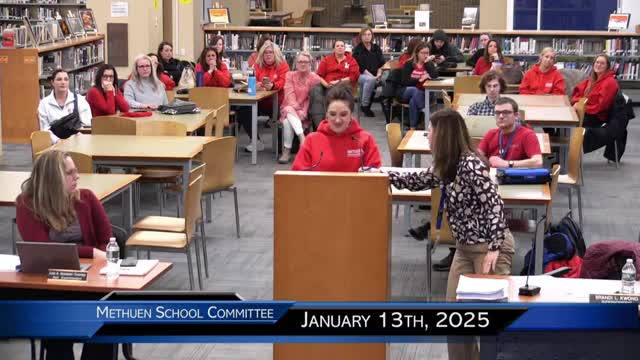
Summary
The Methuen School Committee on Jan. 13 heard repeated public and staff reports about pest infestations, visible water damage and possible mold, and nonfunctioning ventilation systems at several elementary schools, with the district saying it has begun outside testing and deep-cleaning while planning longer-term repairs.
The Methuen School Committee on Jan. 13 heard repeated public and staff reports about pest infestations, visible water damage and possible mold, and nonfunctioning ventilation systems at several elementary schools, with the district saying it has begun outside testing and deep-cleaning while planning longer-term repairs.
Parents, teachers and the Citizens’ Parent Advisory Committee pointed to facility problems at the Marsh, Tenney and Timoney schools and asked for clear timelines. Nicole Pereira, president of the Methuen CPAC, urged the committee to post the state visual inspection and indoor air-quality findings and asked how the district will implement recommendations such as repairing unit ventilators, addressing areas of visible water damage and adopting a vacuuming schedule that uses HEPA filters.
Why it matters: Parents and school staff said facility problems are affecting learning conditions, and speakers called on the committee, mayor and city council for funding and clearer plans. The committee and administration described several immediate actions taken to limit risk and to create transparency for families.
What the district has done so far - Department of Public Health testing: Superintendent and staff said DPH conducted indoor-air testing at the Marsh; the district posted the report online and followed several of DPH’s recommendations. The district said the DPH visit prompted targeted cleaning tasks and ventilation checks. - Contractor cleaning and pest control: The committee approved bringing in outside contractors to deep-clean buildings and to remove rodent droppings and other contamination found during inspections. The district also arranged outdoor rodent control devices at all four elementary schools and the high school and scheduled recurring visits with a pest-control vendor (Pest End) to reduce rodent entry points and conduct sanitation. The chair thanked Pest End for work over the December break and at no immediate extra cost to the schools for initial services. - Ventilation and HVAC checks: Staff reported that some supply and exhaust components were found deactivated or nonfunctional in older building sections; work to identify and repair unit ventilators is underway. School leaders said some elements are beyond normal maintenance and will require capital investment to replace. - Library and collection work: The district contracted with Follett to ‘weed’ and inventory collections at each elementary school, installing new one‑sided wall shelving and buying more than 2,000 permabound titles per elementary school. The high school library was reported at about 14,000 titles. The district said students should be able to begin checking out books by February once weeding and reshelving are finished; self‑checkout kiosks will be added in each building.
What parents and staff asked for Speakers asked for (a) a clear, publicly accessible remediation plan and timeline; (b) a central webpage with inspection results and follow‑up steps; (c) more regular custodial staffing or volunteer schedules to keep carpets and vents cleaned; and (d) capital planning for long‑term replacements (carpets, unit ventilators, ceilings and cabinetry).
Funding and next steps District officials said some short‑term remediation work is being covered temporarily from existing lines while the district awaits state certification of free cash to cover larger contracts. The district also reported it is preparing materials for the state School Building Authority’s accelerated repair programs (letters of interest expected in March) to pursue funding for boilers, windows and other capital needs. The committee and administration discussed recruiting volunteers (senior volunteer program, parents, NJHS students) to assist with reshelving and light maintenance while longer fixes are scheduled.
Discussion tone and context Committee members pressed for a public timeline and asked staff to move with urgency while noting that some repairs require planning (abatement, tile/ceiling replacement) and will take longer than a single maintenance cycle. Several members apologized for any earlier language that might have been perceived as blaming frontline staff; the chair publicly apologized for a broad remark made earlier at a city council meeting and stressed the need for a cooperative approach.
Where this goes from here Superintendent and facilities staff said they will continue posting inspection reports and remediation updates online, pursue state accelerated‑repair funding, schedule deep cleaning during school recesses, and advertise volunteer opportunities. The committee agreed to keep facilities and remediation as a regular agenda item through the spring.