Get Full Government Meeting Transcripts, Videos, & Alerts Forever!
Get email alerts on the Municipal Finance topic
No spam. Unsubscribe anytime.
City advisers outline municipal debt tools as council debates $80 million sports-complex financing
Summary
City financial adviser George Williford and bond counsel Glenn Opel reviewed municipal debt options Jan. 14 and discussed potential structures and hurdles for an approximately $80 million Danny Bell Sports Complex, including legal complexity, rating impacts and a possible short-term bank bridge while audits remain pending.
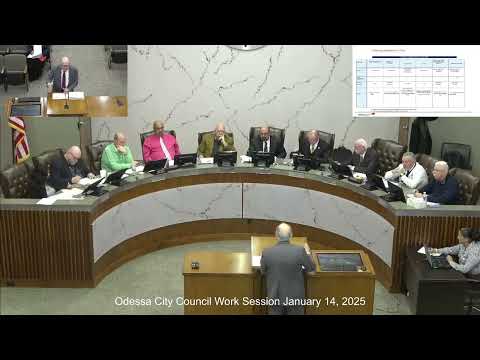
On Jan. 14, 2025, during a City of Odessa work session, financial adviser George Williford of Hilltop Securities and bond counsel Glenn Opel reviewed the debt instruments available to municipalities and discussed financing options for the proposed Danny Bell Sports Complex, an approximately $80,000,000 project under consideration.
The presentation outlined the common instruments cities use to finance projects: general obligation bonds, certificates of obligation (COs), revenue bonds, tax notes and lease-purchase or public property-finance structures. Williford said cities “have the ability to issue general obligation bonds, and certificates of obligation.” He described COs as being treated like general obligation debt by rating agencies and noted that, unlike GO bonds, COs do not require voter approval but do require a published notice period and allow for public petitioning during that period.
Williford reviewed Odessa’s current debt profile and capacity. He told the council the city’s outstanding principal (excluding a recent lease-purchase for water meters) is roughly $202,000,000 and said the city’s taxable value is at about $12,000,000,000. Using standard modeling, he said the city could justify “somewhere 50 to 80,000,000 or so” of new issuance without necessarily pressuring ratings, and that “every $1,000,000 . . . would support about a $13,000,000 issue on 20 year repayment.” Williford also noted differences between self‑supporting utility debt and tax‑supported debt, and that water and sewer revenues can, and in past cases have, fully supported repayment of COs issued for utility projects.
Council members pressed for specifics on capacity and timing. Councilmember Thompson asked about timing for rating reviews once audits are current; Williford said, “If we knew the audit was gonna be released, we try to be proactive . . . a month would be, hopefully, outside.” He also described recent rating activity: Odessa retained a Fitch AA rating; Moody’s and S&P had withdrawn or changed coverage in prior years, he said.
The presentation shifted into a substantive discussion about the Danny Bell Sports Complex and possible financing structures. Council members described the project cost as roughly $80,000,000 and asked whether the city should pursue the project and how it might be financed. Glenn Opel gave a legal assessment and cautioned that the structure discussed to date was “rather complicated.” He said the current plan involved a ground lease to another entity that would issue tax‑exempt bonds, then sublease or leaseback to the city, and that the city’s lease payment “would be a subject to appropriation, lease payment, which would mean it would be . . . on the o and m side.”
Opel and Williford both warned that a lease structured as subject to annual appropriation can draw adverse scrutiny from rating agencies. Opel said the city would need counsel “at every step of that way” to limit risks, and Williford added that such an approach typically carries higher interest rates because “it’s not just about your ability to pay. It’s about your willingness to pay.” Williford and Opel said a leaseback approach that is not rated or that is viewed as non‑appropriated could face a “selective default” treatment by rating agencies and higher borrowing costs.
Council members and advisers discussed alternatives: issuing COs supported by the city’s tax base or using utility revenues for self‑supporting debt; a direct placement or interim “bridge” loan from a bank while audits are finalized; or involvement of the Odessa Development Corporation (ODC) for cash or collateral. Williford described the bridge option and its structure, saying a bridge could include a relatively short call feature so the city could refinance into a longer, rated issue later: “What we call a shorter call on it that would give you the option to refund it, and refinance it, when you get your, you know, on a short maybe a short term. A year or 2. When you get your get your ratings a ratings, you get back in order.”
Advisers noted constraints. Williford said if a bond election fails, the city is precluded from issuing COs for three years. Opel said the proposed leaseback structure was “doable” from a legal standpoint but more complicated and more costly than a straightforward CO issue and that the city should expect higher legal costs and careful drafting to preserve the city’s appropriation control.
Councilmembers also raised questions about using ODC funds and whether spending 4A (economic development corporation) dollars on what some would categorize as 4B projects would be allowed under state law; Opel said that question would require legal research. Advisers recommended that both the financial adviser and bond counsel remain engaged with the project team: “These two gentlemen need to be at every step on those boards,” a council member said.
The presentation concluded with advisers offering to work with staff on modeling specific issuance sizes and structures and with counsel to review vehicle options and legal constraints. No formal financing decision was made at the meeting; the discussion was limited to options, constraints and next steps, including obtaining final audits and more detailed pro forma revenue estimates for the sports complex.
Ending: Council members directed staff to continue refining project documentation and to involve the city’s financial adviser and bond counsel as the design and financing plan develop. Advisers said the audit timing is a key gating factor for market sales and for rating‑agency engagement.