Get Full Government Meeting Transcripts, Videos, & Alerts Forever!
Get email alerts on the Critical Areas Ordinance topic
No spam. Unsubscribe anytime.
Port Orchard planners review proposed Critical Areas Ordinance updates to align with state requirements
Summary
Planning staff and a consultant outlined proposed amendments to Port Orchard Municipal Code 20.162 (the Critical Areas Ordinance), including wetland buffer changes, a wetland mitigation hierarchy, new riparian management zone terminology and a schedule for further public comment and a March hearing.
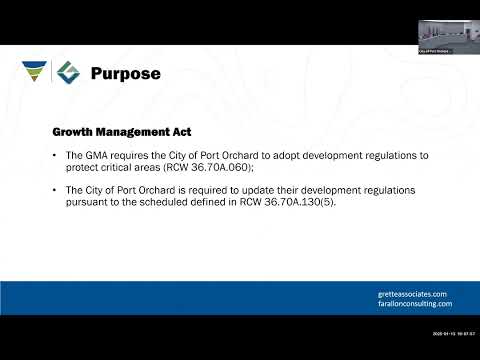
Port Orchard planning staff on Jan. 13 presented proposed revisions to the citymunicipal code 20.162, known as the Critical Areas Ordinance (CAO), saying the amendments are intended to ensure compliance with the Growth Management Act and to integrate the stateDepartment of Fish and Wildlife and other best available science.
"As part of the 2024 comprehensive plan periodic update and the implementation, the city proposes amendments to Port Orchard municipal code 20.162, also known as our critical areas ordinance or CAO," said Jim Fisk, the city's principal planner.
The proposed package, staff said, includes a code reorganization, adjusted wetland buffers, a wetland mitigation hierarchy, replacement of "stream buffer" terminology with "riparian management zone," and standards aimed to satisfy Washington Department of Fish and Wildlife guidance. Chad Wallen, the city's consultant from Grady Associates, described the update as a 10-year periodic alignment driven by state law and new best-available-science (BAS) recommendations.
Why it matters: the Growth Management Act (GMA) and state agency guidance require local governments to periodically update critical-area protections; changes to buffers and mitigation requirements can affect development feasibility, permitting timelines and the city's buildable lands analysis.
Key points from staff and consultant remarks: - Best available science and agency BAS: Wallen and staff said the update relies on BAS prepared by state agencies. For riparian areas, the city is using the Department of Fish and Wildlife's secondary recommendation (standardized buffer distances) rather than DFW's primary, site-specific GIS approach. - On-the-ground determinations: commissioners asked who makes on-site critical-area determinations when features are not mapped. Staff said the typical practice is for an applicant's consultant to prepare the analysis; the city also contracts with consultants to provide that service if the applicant elects to use the city-provided consultant. - Frequency and scope of site assessments: staff said most critical-areas reports are considered valid for five years; after that a consultant typically re-evaluates the site. Wetland delineations are data-driven and often completed in a single day unless the feature is unusually large. - Mitigation sequencing and banking: staff described the sequencing requirement (avoid, minimize, mitigate) and said mitigation banking is treated as a preferred option when available because banks have monitoring and credit milestones that reduce risk compared with on-site mitigation, which can take many years to mature. - Critical aquifer protection: staff explained that critical aquifer recharge areas are categorized (category 1 and 2); the code requires a hydrogeologic report for higher-risk situations (for example, certain fuel or hazardous uses). The report may recommend denial, mitigation, or design changes depending on feasibility and risk.
Process and next steps: staff said the city is developing a comment matrix (a staff disposition of submitted comments) and expects to provide it at the February meeting. The planning commission will have another discussion in February, then a public hearing in March to accept testimony. Staff said the city may ask the commission to recommend adoption with an effective date of Jan. 1 of the following year to allow current public projects to be permitted without redoing critical-areas reports.
Discussion highlights: commissioners probed specifics on how consultants evaluate habitat and how often sites are revisited; staff provided procedural clarifications and cited state code constraints such as takings law that inform the limits of prohibiting uses in recharge areas.
Ending: staff encouraged commissioners and the public to submit written comments ahead of the February meeting; the comment matrix will be circulated before that session and a hearing is expected in March.