Lifetime Citizen Portal Access — AI Briefings, Alerts & Unlimited Follows
Blinken says ceasefire deal is 'on the brink'; outlines Gaza post‑conflict plan
Loading...
Summary
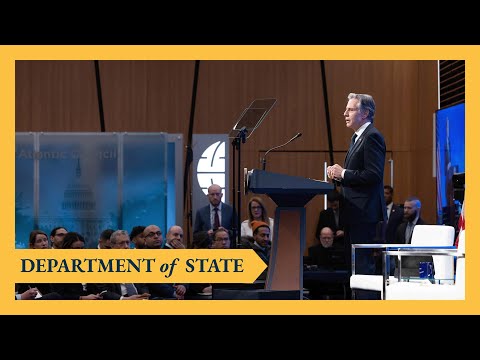
Secretary of State Antony Blinken told an Atlantic Council audience in Washington that a proposed Gaza ceasefire is "on the brink" of acceptance and that a detailed U.S. plan is ready to implement if Hamas accepts the deal.
Secretary of State Antony Blinken told an Atlantic Council audience in Washington that a proposed Gaza ceasefire is "on the brink" of acceptance and that a detailed U.S. plan is ready to implement if Hamas accepts the deal.
Blinken said the United States, Qatar and Egypt submitted a final proposal and that "the deal is ready to be fully and finally accepted." He described core elements the U.S. and partners have developed for post‑conflict Gaza: an interim internationalized administration, an interim security mission of partner nation forces and vetted Palestinian personnel, UN oversight of stabilization and reconstruction, and a time‑bound, conditions‑based pathway toward reunification of Gaza and the West Bank under a reformed Palestinian Authority (PA).
The plan, Blinken said, would hand final responsibility to a reformed PA when feasible and would include international funding, technical support, and oversight. "An interim security mission would be made up of members of partner nation security forces and vetted Palestinian personnel," he said, adding that partners had already expressed willingness to contribute troops and police if an agreement is reached.
Blinken framed the U.S. goal as enabling "a Palestinian state with ironclad security guarantees for Israel," saying a credible political horizon was essential for reconstruction investment and for preventing Hamas from reconstituting itself. He told the audience that, "absent a political dimension...what we're looking at, ultimately, is an enduring insurgency" and said that many regional partners would be reluctant to invest in Gaza's future without a clear political horizon.
He placed the ceasefire push in a broader diplomatic effort: deepening the Abraham Accords, building coalitions such as I2U2, and negotiating what he described as complex U.S.–Saudi elements that would be needed before normalization between Saudi Arabia and Israel. He listed components discussed with Saudi Arabia — a strategic alliance agreement, a defense cooperation agreement, civil nuclear cooperation and an economic package — and said those elements were "ready to go" but dependent on an end to the Gaza conflict and a credible pathway to Palestinian statehood.
On Iran and the nuclear issue, Blinken said the 2015 nuclear agreement had constrained Tehran's fissile material capacity and that, after the U.S. withdrawal, Iran had accelerated enrichment. "We had a big part of Iran's nuclear program in a box with the Iran nuclear deal," he said, adding that restoring verifiable limits would be the preferred and more durable path but that the United States across administrations is determined to prevent Iran from acquiring a nuclear weapon by any means available.
Blinken reviewed regional security developments since the Oct. 7 attacks, saying U.S. diplomacy and coalition action degraded Hamas's military and governance capacity, disrupted Iranian support lines and reduced Hezbollah's capability along Israel's northern border. He described a U.S.‑ and French‑brokered Lebanon arrangement that he said empowers the Lebanese government to retake control of territory south of the Litani River and enables Lebanese security forces to replace Israeli presence in some areas.
He also addressed the humanitarian and human costs in Gaza and Israel. Blinken said "the ongoing humanitarian crisis in Gaza has inflicted immeasurable suffering on Palestinian civilians" and cited large numbers displaced and widespread destruction; he called for measures Israel could take to ease civilian harm, including restarting commercial flows, securing corridors for aid and pauses tied to humanitarian actions.
Protesters interrupted his remarks at points. One unidentified attendee shouted, "For over 450 days, Israel has committed genocide against the Palestinian people," and another during the speech accused U.S. policy of funneling money to Israel, saying, "We have sent over $25,000,000,000 to Israel in the past year." Those remarks were not part of Blinken's prepared remarks and were identified in the transcript as audience interjections.
In a brief question‑and‑answer exchange, the moderator, identified only as Fred, asked whether Hamas had accepted the ceasefire; Blinken replied that final acceptance was pending but "could come in the hours ahead" and that, if accepted, the deal was ready to be implemented. He said the United States had prepared a post‑conflict plan "to hand off" to the incoming administration if necessary.
Blinken closed by urging political will from regional leaders and insisting the United States would continue to press for a diplomatic ending to the conflict that could produce durable security and a path toward Palestinian self‑determination. "We must not squander this chance," he said.
Context and next steps: Blinken said the final agreement is contingent on Hamas's acceptance and on regional political choices, and he said U.S. partners must commit to funding and troop contributions for stabilization, and that the PA will need significant reforms for the plan to proceed.